Biology Topical
Packet
Bonuses Toss-Ups
1) Identify the following types of isomers, for ten points each.
They differ in the covalent arrangements of their atoms, such as butane and isobutane.
Answer: structural isomers
They have the same covalent partnerships, but they differ in their spatial arrangements, such as cis-but-2-ene and trans-but-2-ene.
Answer: geometric isomers
They are mirror images of each other, such as L-Dopa and D-Dopa.
Answer: enantiomers
2) Answer the following about organic functional groups and compounds important in biochemistry, for 2 and 4/13 points each.
Name the functional group consisting of a hydrogen atom bonded to an oxygen atom, which is bonded to a carbon skeleton, and give the name of compounds containing this functional group.
Answer: hydroxyl; alcohol
Name the functional group consisting of a carbon atom joined to an oxygen atom by a double bond, and give the name of compounds containing this group at the end of their carbon skeleton, and give the name of compounds containing this group elsewhere in the carbon skeleton.
Answer: carbonyl; aldehyde; ketone
Name the functional group consisting of an oxygen atom double-bonded to a carbon atome that is also bonded to a hydroxyl group, and give the name of compounds containing this group.
Answer: carboxyl; carboxylic acids
Name the functional group consisting of a nitrogen atom bonded to two hydrogen atoms and to the carbon skeleton, and give the name of compounds containing this group.
Answer: amino; amines
Name the functional group consisting of a sulfur atom bonded to an atom of hydrogen, and give the name of compounds containing this group.
Answer: sulfhydryl; thiols
Name the functional group consisting of a phosphate ion covalently attached by one of its oxygen atoms to the carbon skeleton, and give the name of compounds containing this group.
Answer:
phosphate; organic phosphates
3) Identify the following terms related to biochemical bonding from their definitions, for 4 and 2/7 points each.
A reaction in which two molecules are covalently bonded to each other through the loss of a small molecule.
Answer: condensation reaction
A specific type of condensation reaction in which the molecule lost is water.
Answer: dehydration reaction
A reaction in which bonds are broken by the addition of water molecules; it is the reverse of a dehydration reaction.
Answer: hydrolysis
A long molecule consisting of many identical or similar building blocks linked by covalent bonds.
Answer: polymers
The repeating molecular units which serve as the building blocks of a polymer.
Answer: monomers
The type of bonds between monosaccharides in sugars.
Answer: glycosidic linkages
The type of bonds between amino acids in proteins.
Answer: peptide bonds
4) Answer the following about monosaccharides, for 2.5 points each.
Monosaccharides can be divided into two major categories. In one, the carbonyl group is located on the end of the carbon skeleton, while in the other it is one away from the end. Name these two categories, respectively.
Answer: aldoses (aldehyde sugars); ketoses (ketone sugars)
Most monosaccharides can also be categorized based on how many carbon atoms they contain as triose sugars, pentose sugars, or hexose sugars. For each of the following monosaccharides, classify it based on both its carboyl location and its number of carbons. For example, if I said glucose, you would obviously answer "aldose, hexose".
Ribose
Answer: aldose, pentose
Fructose
Answer: ketose, hexose
Glyceraldehyde
Answer: aldose, triose
Galactose
Answer: aldose, hexose
Ribulose
Answer: ketose, pentose
5) Given a disaccharide, name its two component monosaccharides, for five points each.
Maltose
Answer: glucose, glucose
Lactose
Answer: glucose, galactose
Sucrose
Answer: glucose, fructose
6) Identify the following polysaccharides from their descriptions, for five points each.
A polymer of glucose monomers found in plants, and normally connected by 1-4 linkages, it stores energy.
Answer: starch
The simplest, unbranched form of starch.
Answer: amylose
A branched form of starch with 1-6 linkages at the branch points.
Answer: amylopectin
A highly branched polymer of glucose which stores energy in animals, usually in the liver and muscles.
Answer: glycogen
The most abundant organic compound on Earth, it is similar to starch except that the glucose monomers are in the Beta ring formation rather than the Alpha ring formation, and it is a major component of the cell walls in plants.
Answer: cellulose
A polysaccharide of glucose molecules with nitrogen-containing appendages, it is leathery but hardens when encrusted with calcium carbonate, and is used to build exoskeletons in arthropods.
Answer: chitin
7) Answer the following related to lipids, for three points each.
Fats consist of two major components. The first is an alcohol with three carbons, each bearing a hydroxyl group. The second is a chain of usually 16 to 18 carbons, with a carboxyl group at one end. Name these two components, respectively.
Answer:
glycerol; fatty acid
Fats can be classified into these two categories based on whether there are any double bonds between carbon atoms in the fatty acid hydrocarbon tail.
Answer: saturated, unsaturated
Another term for a fat, this word reflects the fact that a fat consists of three fatty acids linked to one glycerol molecule.
Answer: triacylglycerol
These lipids are similar to fats, except that one of the fatty acids is replaced by a phosphate group.
Answer: phospholipids
This term describes a molecule which is both hyrdophobic and hydrophilic, such as phospholipids.
Answer: ambivalent
These are circular clusters of phospholipids which form in water, with the hydrophilic phosphate heads on the outside and the hydrophobic hydrocarbon tails on the inside.
Answer: micelle
This is a type of lipid characterized by a carbon skeleton consisting of four fused rings. Many function as hormones.
Answer: steroids
Many other steroids are synthesized from this steroid, which is a common component of animal cell membranes, but which may contribute to atherosclerosis.
Answer: cholesterol
8) Answer the following about amino acids, for five points each.
An amino acid consists of a carbon atom bound to a hydrogen atom, a side chain unique to each amino acid, and two functional groups. Name the two functional groups.
Answer: amino, carboxyl
There are twenty amino acids found in proteins, each distinguished by its side chain. Given a description of its side chain, identify the following amino acids.
The simplest amino acid, its side chain is just a hydrogen atom.
Answer: glycine
Its side chain is a methyl group.
Answer: alanine
Its side chain is an isopropyl group, and when it substitutes for glutamic acid in red blood cell proteins, it causes sickle-cell anemia.
Answer: valine
Its side chain is a sulfhydryl group.
Answer:
cysteine
9) Answer the following concerning the four levels of protein structure, for six points each.
A protein's primary structure is its unique sequence of this type of molecule.
Answer: amino acids
A protein's secondary structure is the series of coils and folds which determine its conformation. One of the two most common types of secondary structures is a delicate coil held together by hydrogen bonding between every fourth amino acid, whereas in the other type, two regions of the polypeptide chain lie parallel to each other, with their backbones hydrogen bonded to each other. Name these two structures, respectively.
Answer: alpha-helix; pleated sheet
A protein's tertiary structure consists of irregular contortions from bonding between side chains of the various amino acids. When two cysteine monomers are brought close together, this type of covalent bond can form, riveting parts of the protein together.
Answer: disulfide bridge
A protein may consist of more than one polypeptide chain, and the combination of these chains is known as the protein's quaternary structure. When proteins fold, they are sometimes assisted by other proteins, known by this name, that serve as temporary braces.
Answer:
chaperone proteins
10) Answer the following about nucleotides, for 4 and 2/7 points each.
Nucleotides consist of three major components. Name them.
Answer: nitrogenous base, pentose (prompt on sugar), phosphate group
A nitrogenous base bound to a pentose sugar, without a phosphate group, is known by this term.
Answer: nucleoside
DNA differs from RNA in that its component pentose is lacking an oxygen on its number two carbon. Name the pentoses in DNA and in RNA, respectively.
Answer: deoxyribose, ribose
RNA molecules also differ from DNA molecules in that the nitrogenous base thymine is replaced by this other nitrogenous base.
Answer: uracil
11) Nitrogenous bases can be classified into two families. The first is characterized by six-membered rings of carbon and nitrogen atoms, while the second is characterized by a six-membered ring fused to a five-membered ring. Name these two families, respectively, for 4 and 2/7 points each.
Answer: pyrimidines; purines
Name the three members of the pyrimidine family, for 4 and 2/7 points each.
Answer: cytosine, thymine, uracil
Name the three members of the purine family, for 4 and 2/7 points each.
Answer: adenine, guanine
12) Answer the following concerning the chemical processes in an organism, for six points each.
The totality of an organism's chemical processes is known by this term, which comes from the Greek for "to change".
Answer: metabolism
Metabolism can be divided into processes which release energy by breaking down complex molecules to simpler compounds, and those processes which consume energy to build complicated molecules from simpler ones. Name these two processes, respectively.
Answer: catabolism; anabolism
There are two main types of catabolic pathways. In one, oxygen is consumed as a reactant along with the organic fuel. In the other, sugars are partially degraded without the help of oxygen. Name these two pathways, respectively.
Answer: cellular respiration; fermentation
13) Identify the following terms related to biological catalysts from their definitions, for three points each.
The general term for catalytic proteins.
Answer: enzymes
The reactant on which an enzyme acts.
Answer: substrate
The region of an enzyme molecule which actually binds to the substrate, typically a pocket or groove on its surface.
Answer: active site
Nonprotein molecules which assist enzymes, usually by binding permanently or reversibly to the active site.
Answer: cofactors
Organic molecules which act as cofactors.
Answer: coenzymes
Molecules which resemble the structure of a substrate and compete for admission to the active site, reducing the productivity of enzymes by blocking the substrates from entering the active sites.
Answer: competitive inhibitors
Molecules which bind to some part of an enzyme other than its active site, causing it to change conformation, making its active site unreceptive to its substrate.
Answer: noncompetitive inhibitors
A receptor site on an enzyme to which noncompetitive inhibitors can bind.
Answer: allosteric site
The process by which a metabolic pathway is turned off by its end-product, which acts as an inhibitor of an enzyme within the pathway.
Answer: feedback inhibition
An interaction of the constituent subunits of a protein causing a conformational change in one subunit to be transmitted to all the others.
Answer: cooperativity
14) Identify the following instruments used in the study of cells, for 7.5 points each.
In this type of microscope, visible light is passed through the specimen and then through glass lenses, which refract the light in such as way that the image is magnified as it is projected into the eye.
Answer: light microscope
In this type of microscope, a beam of electrons is focused using electromagnets through sections of preserved cells stained with atoms of heavy metals.
Answer: transmission electron microscope (prompt on just electron microscope)
In this type of microscope, the electron beam scans the surface of the sample, which is coated with a thin film of gold, producing a three-dimensional topography of the specimen.
Answer: scanning electron microscope (prompt on jus electron microscope)
These machines, which spin at up to 80,000 rpm, are used for cell fractionation, separating the major organelles so their individual functions may be studied.
Answer: ultracentrifuge
15) Answer the following about the basics of cells, for six points each.
Cells may be classified into two major categories. One, whose name comes from the Greek for "before kernel", has no nucleus. The other, whose name comes from the Greek for "true kernel", has a membrane-bound nucleus and membrane-bound organelles. Name these two categories, respectively.
Answer: prokaryotes; eukaryotes
The DNA in a prokaryote is concentrated in a region known by this name.
Answer: nucleoid
The entire region between the nucleus in a eukaryote and the cell membrane is known by this name.
Answer: cytoplasm
The cytoplasm consists of organelles suspended in this semifluid medium.
Answer: cytosol
16) In this bonus, and the eight which follow, we will examine the components of a eukaryotic cell. In this bonus, identify the following terms related to the nucleus, for six points each.
A double membrane, each a lipid bilayer with associated proteins, which is perforated by pores and surrounds the nucleus.
Answer:
nuclear envelope
A netlike array of protein filaments which lines the nuclear side of the nuclear envelope and maintains the shape of the nucleus.
Answer: nuclear lamina
Material within the nucleus consisting of DNA organized along with proteins.
Answer: chromatin
Chromatin that is coiled into thick structures as the cell prepares to divide.
Answer: chromosomes
A structure within the nucleus where components of ribosomes are synthesized.
Answer: nucleolus
17) Identify the following terms related to the endomembrane system from their definitions, for 3.75 points each.
An extensive membranous network which is continuous with the outer nuclear membrane, composed of ribosome-studded and ribosome-free regions.
Answer: endoplasmic reticulum
The network of membranous tubules and sacs which compose endoplasmic reticulum.
Answer: cisternae
The internal compartment of endoplasmic reticulum.
Answer: cisternal space
This structure receives transport vesicles with materials produced by the endoplasmic reticulum at its cis-face, and releases its products from its trans-face.
Answer: Golgi apparatus
A membrane-bounded sac of hydrolytic enzymes which the cell uses to digest macromolecules.
Answer:
lysosome
The two types of membrane-bound sacs in the cell, differentiated by their size.
Answer: vesicles, vacuoles
The membrane which encloses the large central vacuole in mature plant cells.
Answer: tonoplast
18) Identify the following terms related to the site of cellular respiration from their definitions, for ten points each.
The organelle in which cellular respiration takes place
Answer: mitochondrion
The infoldings of the mitochondrion's inner membrane, which give the membrane a large surface area, enhancing the productivity of cellular respiration.
Answer: cristae
The compartment in the mitochondrion within the inner membrane, in which some of the metabolic steps of cellular respiration take place.
Answer: mitochondrial matrix
19) Identify the following terms related to plastids in plant cells from their definitions, for five points each.
Colorless plastids which store starch, particularly in roots and tubers.
Answer:
amyloplasts
Plastids which are rich in pigments which give fruits and flowers their orange and yellow hues.
Answer: chromoplasts
Plastids which contain the green pigment chlorophyll along with enzymes and other molecules that function in the photosynthetic production of food.
Answer:
chloroplasts
The membranous system of flattened sacs inside the chloroplast.
Answer: thylakoids
Structures of thylakoids, stacked like poker chips.
Answer: grana
The fluid outside the thylakoids inside a chloroplast.
Answer: stroma
20) Identify the following terms related cell organelles not included in the previous bonuses, from their definitions, for 7.5 points each.
The sites where the cell makes proteins; they can be either free or bound.
Answer: ribosomes
Membrane-bound compartments which transfer hydrogen from substrates to oxygen, used to break down large molecules or detoxify harmful compounds.
Answer: peroxisomes
Peroxisomes produce this toxic chemical as a by-product, but contain enzymes to convert it to water.
Answer: hydrogen peroxide
Specialized peroxisomes in the fat-storing tissues of plant seeds which convert fatty acids to sugar.
Answer: glyoxysomes
21) Identify the following terms relating to the network of fibers in the cytoplasm of a cell from their definitions, for five points each.
The general term for the entire network of fibers in the cytoplasm which contributes to cell organization and activity.
Answer: cytoskeleton
There are three major components of the cytoskeleton. Identify them from their descriptions.
These fibers are hollow tubes made of alpha and beta tubulin, which form compression-resisting girders, contribute to cell motility, move chromosomes in cell division, and move organelles.
Answer: microtubules
These fibers are two intertwined strands of actin, which function in cytoplasmic streaming, cell motility, tension-bearing, and cell division.
Answer: microfilaments
These fibers are proteins of the keratin family supercoiled into thick cables, which anchor some organelles, form nuclear lamina, and bear tension.
Answer: intermediate filaments
Name the region near the nucleus which is also known as the microtubule-organizing center, from which microtubules grow.
Answer: cerntrosome
Name the pair of structures in animal cells which are composed of nine sets of triplet microtubules arranged in a ring, and replicate during cell division.
Answer: centrioles
22) Identify the following terms related to cell motility from their definitions, for 4 and 2/7 points each.
A locomotive appendage which undulates, driving a cell in the same direction as the axis of the appendage; there are usually no more than one or a few per cell.
Answer: flagellum
Locomotive appendages which work like oars, moving the cell in a direction perpendicular to its axis; there may be many per cell.
Answer: cilia
Cellular extensions by which a cell can crawl along a surface in ameboid movement.
Answer: pseudopodia
The two proteins which are interdigitated in muscle cells, and whose contractions and extensions can cause movement.
Answer: actin, myosin
A large contractile protein which forms the sidearms of microtubule doublets in cilia and flagella.
Answer: dynein
A structure similar to a centriole which anchors a cilium or flagellum.
Answer:
basal body
23) There are three main types of interceullular junctions in animals. Identify them from their descriptions, for ten points each.
These connections form continuous belts around the cell, and the membranes of neighboring cells are actually fused, forming a seal that prevents leakage of extracellular fluid.
Answer: tight junctions
These junctions function like rivets, fastening cells together into strong epithelial sheets.
Answer: desmosomes
These connections provide cytoplasmic channels between adjacent cells, and special membrane proteins surround each pore, which is wide enough for small molecules to pass through.
Answer: gap junctions
24) Identify the following terms related to the substance in which animal tissue cells are embedded from their definitions, for five points each.
The general term for the substance of proteins and polysaccharides in which animal tissue cells are embedded.
Answer: extra-cellular matrix
The general term for proteins covalently bonded to carbohydrates, which are the major component of the extra-cellular matrix.
Answer: glycoproteins
The most abundant protein in animals, it forms strong fibers in the extra-cellular matrix and is found extensively in connective tissue and bone.
Answer: collagen
A type of glycoprotein containing up to 95% carbohydrate which forms complex networks in the extra-cellular matrix.
Answer: proteoglycans
Receptor proteins which are built into the plasma membrane, spanning the membrane and bound to microfilaments of the cytoskeleton, allowing them to transmit changes in the extra-cellular matrix to the cytoskeleton and vice versa.
Answer: integrins
A type of glycoprotein in the extra-cellular matrix which bind to integrins.
Answer: fibronectins
25) Answer the following related to cell membranes, for 7.5 points each.
The currently accepted model of cellular membranes holds that proteins are dispersed and individually inserted into a bilayer of phospholipids.
Answer: fluid mosaic model
There are two major types of membrane proteins. One type are generally trans-membrane proteins, with hydrophobic regions that completely span the hydrophobic interior of the membrane. The other type are not embedded in the lipid bilayer but rather are appendages loosely to the surface of the membrane. Name these two types, respectively.
Answer: integral proteins; peripheral proteins
Most membrane carbohydrates are branched with fewer than 15 sugar units, known by this name, from the Greek for "few".
Answer: oligosaccharides
26) Identify the following terms related to passive transport from their definitions, for 4 and 2/7 points each.
The tendency for molecules of any substance to spread out into the available space.
Answer: diffusion
The difference in molecules of a substance per volume in two different regions, down which the substance will diffuse.
Answer: concentration gradient
The diffusion of water across a selectively permeable membrane.
Answer: osmosis
The control of water balance in a cell
Answer:
osmoregulation
Give, respectively, the relative terms for a solution with higher concentration, lower concentration, and the same concentration as a given solution.
Answer: hypertonic; hypotonic; isotonic
27) A cell may gain or lose water depending on the concentration of its environment relative to itself. Give, respectively, the terms for an animal cell in hypertonic, isotonic, and hypotonic solutions, for five points each.
Answer: shriveled; normal; lysed
Give, respectively, the terms for a plant cell in hypertonic, isotonic, and hypotonic solutions, for five points each.
Answer: plasmolyzed; flaccid; turgid
28) Answer the following related to active transport, for 7.5 points each.
One of the most important transport systems in cells is a pump which creates steep concentration gradients by transporting three molecules of one cation out of the cell for every two molecules of another cation pumped into the cell. Name the two cations, respectively.
Answer: sodium; potassium
This type of pump actively transports hydrogen ions out of the cell.
Answer: proton pump
Transports, such as the sodium-potassium pump and the proton pump, which generate a voltage across a membrane by transferring charge across the membrane, are known by this name.
Answer: electrogenic pump
29) Identify the following terms related to the transport of large molecules across a membrane from their definitions, for six points each.
The secretion of macromolecules out of the cell by the fusion of vesicles with the plasma membrane.
Answer: exocytosis
The reception of macromolecules and particulate matter into the cell by forming new vesicles from the plasma membrane.
Answer: endocytosis
A type of endocytosis in which a cell engulfs a particle by wrapping pseudopodia around it and packaging it within a vacuole; it is also known as "cellular eating".
Answer: phagocytosis
A type of endocytosis in which the cell gulps droplets of extracellular fluid in tiny vesicles; it is also known as "cellular drinking".
Answer: pinocytosis
A type of endocytosis in which proteins in the membrane with specific receptor sites are exposed to the extracellular fluid, making the transport specific to certain substances.
Answer: receptor-mediated endocytosis
30) Answer the following about the splitting of sugar, for three points each.
Give the general term for the catabolic pathway which breaks down glucose molecules, the first process in cellular respiration and fermentation.
Answer: glycolysis
In glycolysis, one molecule of glucose is converted into two molecules of this compound.
Answer: pyruvate
Through the glycolysis pathway, for each molecule of glucose, two molecules of one compound are phosphorylated from ADP, and two molecules of another compound are reduced from NAD+. Give the full names of these two compounds, respectively.
Answer: adenosine triphosphate; nicotinamide adenine dinucleotide hydride
Glycolysis is a ten-step pathway, involving ten enzymes. Name the two enzymes which phosphorylate ADP to make ATP, and the two enzymes which phosphorylate glucose from ATP, forming ADP.
Answer: phosphoglycerokinase, pyruvate kinase; hexokinase, phosphofructokinase
Name the two intermediates in the glycolysis pathway which have two phosphate groups attached.
Answer: fructose 1,6-biphosphate, 1,3-bisphosphoglycerate
31) Answer the following concerning cellular respiration after glycolysis, for five points each.
Upon entering the mitochondrion, a molecule of pyruvate is converted into two compounds, as it reacts with Coenzyme A, and one molecule of NAD+ is reduced to NADH. Name these two compounds.
Answer: acetyl CoA, carbon dioxide
Name the cycle of reactions which takes place in the mitochondrion, reducing three molecules of NAD+, reducing one molecule of FAD, phosphorylating one molecule of ADP, and releasing two molecules of carbon dioxide, for each molecule of acetyl CoA.
Answer: Krebs cycle
Identify the following intermediates in the Krebs cycle from their descriptions.
This six-carbon molecule is formed immediately after the addition of an acetyl CoA molecule.
Answer: citrate
This four-carbon molecule is formed immediately following the release of Coenzyme A and the phosphorylation of ADP into ATP.
Answer: succinate
This four-carbon molecule is formed from malate and is the immediate precursor of citrate.
Answer: oxaloacetate
32) Identify the following terms related to the completion of cellular respiration from their definitions, for six points each.
A series of reactions in the mitochondrion membrane that uses FADH2 and NADH molecules produced in glycolysis and the Krebs cycle and breaks the fall of electrons to oxygen into several energy-releasing steps instead of one explosive reaction.
Answer: electron transport chain
The production of ATP using energy derived from the redox reactions of an electron transport chain.
Answer:
oxidative phosphorylation
The production of ATP using the energy of hydrogen-ion gradients created by the electron transport chain to phosphoylate ADP into ATP.
Answer: chemiosmosis
The potential energy stored in the form of an electrochemical gradient, generated by the pumping of hydrogen ions across biological membranes during chemiosmosis.
Answer:
proton-motive force
A cluster of several membrane proteins found in the mitochondrial cristae that use the energy of a hydrogen-ion concentration gradient to make ATP.
Answer:
ATP synthase
33) Identify the following terms related to catabolic pathways other than cellular respiration from their definitions, for ten points each.
A catabolic process which makes a limited amount of ATP from glucose without an electron transport chain, oxidizing NADH back to NAD+ by some alternate mechanism.
Answer: fermentation
In this type of fermentation, common in yeast, pyruvate molecules are converted into acetaldehyde, which is then reduced to ethanol as NADH is oxidized to NAD+.
Answer: alcohol fermentation
In this type of fermentation, common in human muscles, pyruvate molecules are reduced to lactate as NADH is oxidized to NAD+.
Answer: lactic acid fermentation
34) Identify the following terms related to the first of the two processes involved in photosynthesis from their definitions, for three points each.
The collective name for this process, which uses solar energy to split water, transferring the electrons and hydrogen atoms to nicotinamide adenine dinucleotide phosphate and phosphorylating ADP to ATP.
Answer: light reactions
In the thylakoid membrane, chlorophyll is organized along with proteins and other small organic molecules into these systems, which can absorb light.
Answer: photosystems
There are two photosystems, each with a reaction-center chlorophyll molecule named for the wavelengths at which it absorbs light. Give the names of the reaction-centers for Photosystem I and Photosystem II, respectively.
Answer: P700; P680
When P680 absorbs light, two electrons are excited and jump to a specialized chlorophyll a molecule. The electron "hole" in P680 is filled by splitting water into oxygen, hydrogen atoms, and electrons. The excited electrons then cascade down an electron transport chain consisting of three types of electron carriers. The electrons end up filling the electron "hole" in P700, which is created when it absorbs light, exciting some of its electrons into another of the specialized chlorophyll a molecules. These electrons then fall down another electron transport chain consisting of an iron-containing protein. At the end, an enzyme transfers the electrons from this protein to NADP+, creating NADPH. Give the name for the specialized chlorophyll a molecule, the three types of electron carriers in the first electron transport chain, the iron-containing protein, and the enzyme which transfers electrons to NADP+, respectively.
Answer: primary acceptor; plastoquinione, cytochromes, plastocyanin; ferredoxin; NADP+ reductase
35) Answer the following about photosynthetic pigments, for five points each.
This blue-green pigment is the only one which can participate directly in the light reactions.
Answer: chlorophyll a (prompt on just chlorophyll)
This yellow-green accessory pigment is almost identical to chlorophyll a, but has a slightly different absorption spectrum.
Answer: chlorophyll b
Other accessory pigments are hydrocarbons of various shades of yellow and orange, and function in photoprotection, dissipating excessive light energy which might damage chlorophyll.
Answer:
caretenoids
Name the two colors of light most effective for photosynthesis, and the least effective color.
Answer: red, blue; green
36) Identify the following terms related to the second step in photosynthesis from their definitions, for ten points each.
The cycle of reactions in the chloroplast which uses nine molecules of ATP and six molecules of NADPH produced by the light reactions to convert three molecules of carbon dioxide to one molecule of a sugar.
Answer: Calvin cycle
The three-carbon phosphorylated sugar which is directly produced by the Calvin cycle.
Answer: glyceraldehyde-3-phosphate (prompt on G3P)
The most abundant protein on Earth, which serves as an enzyme to attach a carbon dioxide molecule to ribulose bisphosphate in the Calvin cycle.
Answer: rubisco (or ribulose bisphosphate carboxylase)
37) Identify the following terms related to carbon fixation from their definitions, for 3 and 1/3 points each.
A plant which uses the Calvin cycle for the initial steps that incorporate carbon dioxide into organic material, forming a three-carbon compound as the first stable intermediate.
Answer: C3 plant
A metabolic pathway that consumes oxygen, releases carbon dioxide, generates no ATP, and decreases photosynthetic output; it usually occurs on hot, dry, bright days when stomata close and the oxygen content in a leaf exceeds that of carbon dioxide.
Answer: photorespiration
A plant which combats photorespiration by prefacing the Calving cycle with reactions that incorporate carbon dioxide into four-carbon compounds, the end-product of which supplies carbon dioxide for the Calvin cycle.
Answer: C4 plant
In C4 plants, there are two types of photosynthetic cells. One type are tightly arranged around the veins of the leaf, and are the only type in which the Calvin cycle occurs. The other type are loosely arranged on the leaf surface, and incorporate carbon dioxide into four-carbon sugars. Name these two types of cells, respectively.
Answer: bundle-sheath cells; mesophyll cells
In C4 plants, carbon dioxide is added to a three-carbon molecule by an enzyme to form a four-carbon sugar. Name the three-carbon sugar, the enzyme, and the four-carbon sugar, respectively.
Answer: phosphoenolpyruvate (PEP); PEP carboxylase; oxaloacetate
This type of metabolism is used by some plants to combat photorespiration by converting carbon dioxide that enters open stomata at night into organic acids which release carbon dioxide for the Calvin cycle during the day, when the stomata are closed to conserve water.
Answer: crassulacean acid metabolism (prompt on CAM)
38) Identify the following terms related to cell communication from their definitions, for 3 and 1/3 points each.
This is a series of steps involving reception, transduction, and response by which a cell takes action based on external signals.
Answer: signal-transduction pathway
This type of protein is activated when a receptor protein in the membrane is activated by a signal molecule and displaces a GDP molecule on this protein with a GTP molecule, activating this protein, which in turn activates enzymes which lead to a cellular response.
Answer: G-protein
When activated, the cytoplasmic side of this type of receptor protein catalyzes the transfer of phosphate groups from ATP to an amino acid on a substrate protein.
Answer: tyrosine-kinase receptor
These channels are protein pores in the plasma membrane that open or close in response to a chemical signal, allowing or blocking the flow of specific ions, such as Na+ or Ca2+.
Answer: ligand-gated ion channels
This term refers to small, nonprotein, water-soluble molecules or ions which relay signals within a cell.
Answer:
second messangers
This ring-shaped molecule made from ATP is a second messenger.
Answer: cyclic adenosine monophosphate (or cyclic AMP)
This enzyme converts ATP to cyclic AMP in response to an external signal, such as epinephrine.
Answer: adenylyl cyclase
These two second messengers are produced by cleavage of the phospholipids in the plasma membrane, and lead to the release of calcium from the endoplasmic reticulum.
Answer: diacylglycerol (DAG), inositol trisphosphate (IP3)
39) Answer the following terms related to the cell cycle, for three points each.
This term refers to the cell's total hereditary endowment of DNA.
Answer: genome
All eukaryotic cells can be classified into two categories, reproductive cells and non-reproductive cells. Give the names and the number of chromosomes present in the human versions of each category, respectively.
Answer: gametes : 23; somatic cells : 46
Each chromosome duplicated in preparation for cell division consists of two of these, which are identical copies of the chromosome's DNA molecule. They are separated during cell division.
Answer: sister chromatids
This is the centralized region joining two sister chromatids.
Answer: centromere
Each chromatid has this structure of proteins and specific sections of chromosomal DNA at the centromere. They are pulled apart during cell division.
Answer: kinetochores
This assemblage of microtubules orchestrates chromosome movement during cell division, pulling the kinetochores apart.
Answer: mitotic spindle
This structure is a double membrane across the midline of a dividing plant cell, between which the new cell wall forms.
Answer: cell plate
40) Answer the following about the phases of the cell cycle, for 2.5 points each.
There are two major phases in the cell cycle. During the first, which often accounts for ninety percent of the cycle, the cell grows and copies its chromosomes. During the second, the cell divides. Name these two phases, respectively.
Answer: interphase; mitotic phase
There are three phases within interphase. During the first, the cell begins to grow. During the second, the cell continues to grow while replicating its DNA. During the third, the cell completes its growth. Name these three phases, respectively.
Answer: G1 (gap 1); S; G2 (gap 2)
There are six phases within the mitotic phase. Identify them from their descriptions, which are given in chronological order.
In this phase, chromatin fibers condense into chromosomes. The nucleoli disappear. Each duplicated chromosome appears as two identical sister chromatids joined together. The mitotic spindle begins to form. The centrosomes move away from each other.
Answer: prophase
In this phase, the nuclear envelope fragments. Each of the two chromatids of a chromosome now have developed a kinetochore, and some microtubules attach to the kinetochores.
Answer: prometaphase
In this phase, the centrosomes have reached opposite poles. The chromosomes convene on an imaginary plane equidistant between the two poles. The sister chromatids of each chromosome straddle this metaphase plate.
Answer: metaphase
In this phase, the paired centromeres of each chromosome separate, liberating the sister chromatids from each other. The kinetochore microtubules shorten, moving the chromatids to opposite poles.
Answer: anaphase
In this phase, nuclei form at the two poles of the cell. Nuclear envelopes arise, and the chromosomes become less tightly coiled. Mitosis is completed.
Answer: telophase
In this phase, separate from mitosis, which is the replication of the nucleus, but still in the mitotic phase, the cytoplasm is divided, forming two new daughter cells.
Answer: cytokinesis
In animal cells, cytokinesis initially forms this structure, which pinches the cell in two.
Answer: cleavage furrow
41) Identify the following terms related to phosphorylating enzymes from their definitions, for six points each.
An enzyme that transfers phosphate groups from ATP to a protein.
Answer: protein kinase
An enzyme that remove phosphate groups from proteins.
Answer: protein phosphatase
A protein with a cyclically fluctuating concentration in the cell.
Answer: cyclin
A phosphate-transferring enzyme which must be attached to a cyclin protein to be activated.
Answer: cyclin-dependent kinase (Cdks)
The first cyclin-dependent kinase to be discovered, it triggers the cell's passage past the G2 checkpoint into M phase.
Answer: maturation promoting factor (MPF)
42) Identify the following terms related to cancer from their definitions, for six points each.
A mass of abnormal cells within an otherwise normal tissue.
Answer: tumor
The process that converts a normal cell to a cancer cell.
Answer: transformation
A type of tumor in which the abnormal cells remain at the original site, and can usually be completely removed by surgery.
Answer: benign tumor
A type of tumor which is invasive and can impair the function of organs.
Answer: malignant tumor
The spread of cancer cells beyond their original site.
Answer: metastasis
43) Answer the following terms related to cell divisions which create gametes, for 2.5 points each.
This type of cell division produces gametes with half the chromosome number of the original cell. In Phase I, homologous chromosomes are separated, while in Phase II, which is similar to mitosis, sister chromatids are separated.
Answer: meiosis
Another term for fertilization, this refers to the union of gametes.
Answer: syngamy
This term refers to a fertilized egg.
Answer: zygote
All eukaryotic cells can be classified into two categories, depending on whether they have one or two sets of chromosomes. Name these two categories, respectively.
Answer: haploid; diploid
In this process during prophase I of meiosis, the duplicated chromosomes pair with their homologues.
Answer: synapsis
This term refers to the four closely associated chromatids of a homologous pair.
Answer: tetrad
This process is the reciprocal exchange of genetic material between nonsister chromatids during synapsis of meiosis I.
Answer: crossing over
This X-shaped region represents homologous chromatids that have exchanged genetic material through crossing over.
Answer: chiasma
The typical plant life cycle consists of both a multicellular diploid form and a multicellular haploid form. Give the name for this life cycle, as well as the names for both the diploid and haploid stages, respectively.
Answer: alternation of generations; sporophyte; gametophyte
44) Identify the following terms related to genetics from their definitions, for 1 and 7/8 points each.
A heritable feature, such as flower color, that varies among individuals.
Answer: character
Each variant of a character, such as a purple flower.
Answer: trait
The mating, or crossing, of two varieties.
Answer: hybridization
Plants which, when they self-pollinate, have offspring of all the same variety.
Answer:
true-breeding
Alternative versions of a gene.
Answer: alleles
Having a pair of identical alleles for a character.
Answer:
homozygous
Having two different alleles for a gene.
Answer: heterozygous
The allele which is expressed when an organism is heterozygous for a character.
Answer: dominant allele
The allele which is not expressed when an organism is heterozygous for a character.
Answer: recessive allele
The genetic makeup of an organism, noting all its dominant and recessive alleles
Answer: genotype
The appearance of an organism, determined by the expression of its genotype
Answer: phenotype
Mendel's first law, which states that allele pairs separate during gamete formation, and then randomly re-form pairs during the fusion of gametes at fertilization.
Answer: law of segregation
Breeding of an organism of unknown genotype with a homozygous recessive individual to determine the unknown genotype.
Answer: testcross
Give the names of the first three generations in a monohybrid cross.
Answer: P (parental), F1 (first filial), F2 (second filial)
45) Answer the following related to Mendel's second law, for ten points each.
Name Mendel's second law, which states that each allele pair segregates independently during gamete formation, and applies when genes for two traits are located on different pairs of homologous chromosomes.
Answer: law of independent assortment
Use the law of independent assortment to answer the following question. Assume yellow seeds are dominant to green seeds and that round seeds are dominant to wrinkled seeds. Cross a homozygous yellow-round seed with a homozygous green-wrinkled seed, and then self-pollinate the F1 generation. What will be the ratio of yellow-round to green-round to yellow-wrinkled to green-wrinkled seeds in the F2 generation?
Answer: 9:3:3:1 (YYRR*yyrr = YyRr for F1)
Use the law of multiplication to answer the following question. Assume purple flowers are dominant to white flowers, yellow seeds are dominant to green seeds, and round seeds are dominant to wrinkled seeds. A gardener crosses pure-breeding purple-flowered, yellow-round seeded peas with white-flowered, green-wrinkled peas. What fraction of the F2 generation are expected to be pure-breeding with white flowers and round seeds and heterozygous with regard to seed color?
Answer: 1/32 (PPYYRR*ppyyrr = PpYyRr for F1 , 1/4 pp, 1/2 Yy, 1/4 RR in F2)
46) Identify the following terms related to problems with simple Mendelian genetics from their definitions, for five points each.
A type of inheritance in which F1 hybrids have an appearance that is intermediate between the phenotypes of the parental varieties.
Answer: incomplete dominance
A type of inheritance in which both alleles are separately manifest in the phenotype.
Answer: codominance
The ability of a gene to affect an organism in many ways.
Answer: pleiotropy
The ability of a gene at one locus to alter the phenotypic expression of a gene at a second locus.
Answer: epistasis
An additive effect of two or more genes on a single phenotypic quantitative character.
Answer: polygenic inheritance
The range of phenotypic possibilities over which a genotype may be expressed due to environmental variations.
Answer: norm of reaction
47) Identify the following genetic diseases from their descriptions, for 7.5 points each.
It is the most common lethal genetic disease in the US, and is caused by the lack of a membrane protein that transports chloride ion between cells and the extracellular fluid, causing a buildup of mucus.
Answer: cystic fibrosis
Most common among Ashkenazic Jews, it is caused by a dysfunctional enzyme that fails to break down brain lipids of a certain class, and causes death within a few years.
Answer: Tay-Sachs disease
The most common inherited disease among blacks, it is caused by the substitution of one amino acid in hemoglobin, deforming red blood cells. Those who are carriers of this disease may be more resistant to malaria.
Answer: sickle-cell anemia
One of the few lethal diseases caused by a dominant allele, it has no obvious effect until the individual is at least 35 years old, but then begins an irreversible and fatal deterioration of the nervous system.
Answer: Huntington's disease
48) Identify the following terms related to the chromosomal basis of inheritance from their definitions, for 4 and 2/7 points each.
The most common phenotype in the natural population.
Answer: wild type
Traits that are alternatives to the wild type.
Answer: mutant phenotypes
Offspring whose phenotype matches exactly matches that of one of its parent's phenotypes.
Answer: parental type
Offspring whose phenotype is different from both of its parents' phenotypes.
Answer: recombinant
Genes which are located on the same chromosome and therefore tend to be inherited together.
Answer: linked genes
The location of a gene on a chromosome.
Answer: locus
An ordered list of genetic loci along a chromosome, created by using recombination frequencies.
Answer: linkage map (prompt on genetic map)
49) There are several different chromosomal systems which determine the sex of an organism. In the X-Y system, males have an X chromosome and a Y chromosome, while females have two X chromosomes. In the X-0 system, males have just an X chromosome, while females have two X chromosomes. In the Z-W system, males have two Z chromosomes, while females have a Z chromosome and a W chromosome. In the haplo-diploid system, males are haploid and females diploid. Given an organism, identify which system it uses, for 3 and 1/3 points each.
Birds
Answer: Z-W
Grasshoppers
Answer: X-0
Fish
Answer: Z-W
Mammals
Answer: X-Y
Bees
Answer: haplo-diploid
Fruit flies
Answer: X-Y
Ants
Answer: haplo-diploid
Crickets
Answer: X-0
Roaches
Answer: X-0
50) Answer the following related to genetic diseases, for 2 and 1/7 points each.
This X-linked disorder is caused by the absence of the protein dystrophin and is characterized by a progressive weakening of the muscles.
Answer: Duchenne muscular dystrophy
This X-linked disorder is caused by the absence of a protein required for blood clotting.
Answer: hemophilia
This term refers to the failure of a pair of homologous chromosomes to move apart properly during meiosis I or the failure of sister chromatids to separate during meiosis II.
Answer: nondisjunction
This term refers to offspring with an abnormal chromosome number, resulting from nondisjunction.
Answer: aneuploidy
This term refers to the type of aneuploidy in which three copies of a chromosome are present.
Answer: trisomy
This term refers to organisms with more than two complete chromosome sets.
Answer: polyploidy
This disease is caused by trisomy of chromosome 21.
Answer: Down syndrome
People with this disease have an extra X chromosome.
Answer: Klinefelter syndrome
People with this disease have only one sex chromosome, an X chromosome.
Answer: Turner syndrome
This disease is caused by a deletion on chromosome 5 and is characterized by mental retardation, a small head, and a distinctive cry.
Answer: cri du chat
In this process, certain genes are marked in each generation in a way to distinguish whether the gene resides in a female or male, meaning an allele can have different effects on offspring depending on whether it is from the mother or father.
Answer: genomic imprinting
Both of these diseases are caused by a deletion in chromosome 15, but have different symptoms depending on whether the abnormal chromosome was inherited from the mother or father. Name the disease caused by maternal inheritance and the disease caused by paternal inheritance, respectively.
Answer: Angelman; Prader-Willi
In this disease, which is also related to genomic imprinting, the tip of an abnormal X chromosome hangs off the rest of the chromosome by a thin thread of DNA, causing mental retardation.
Answer: fragile X syndrome
51) Identify the following terms related to DNA replication from their definitions, for 2 and 1/7 points each.
Special sites where the two strands of parental DNA form replication bubbles, allowing replication to begin.
Answer: origins of replication
A Y-shaped region at each end of a replication bubble where the new strands of DNA are elongated.
Answer: replication fork
Enzymes which catalyze the elongation of new DNA at the replication fork.
Answer: DNA polymerases
The DNA strand which is made in the natural 5' to 3' direction, from the phosphate on the fifth carbon of one sugar molecule to the hydroxyl group on the third carbon of another sugar molecule.
Answer: leading strand
The DNA strand which is made in the opposite, 3' to 5', direction.
Answer: lagging strand
The series of short segments which are synthesized backwards and then joined together to form the lagging strand, since elongation can only occur in the 5' to 3' direction.
Answer: Okazaki fragments
The enzyme which joins the Okazaki fragments into the lagging strand.
Answer: DNA ligase
A short stretch of preexisting RNA which DNA polymerases elongate, necessary since DNA polymerases cannot initiate synthesis of a polynucleotide.
Answer: primer
The enzyme which joins RNA nucleotides to make the primer.
Answer: primase
The enzyme which untwists the double helix at the replication fork.
Answer: helicase
The proteins which hold the unpaired DNA strands apart while complementary strands are synthesized.
Answer: single-strand binding proteins
A type of DNA repair mechanism in which DNA polymerase fixes mistakes that are made during copying.
Answer: mismatch repair
A type of DNA repair mechanism in which a segment of damaged DNA is cut out and replaced.
Answer: excision repair
The enzyme which cuts out damaged DNA in excision repair.
Answer: nuclease
52) Answer the following terms related to the synthesis of RNA from a DNA template, for 2.5 points each.
Give the term for the synthesis of RNA on a DNA template.
Answer: transcription
Name the system by which genetic instructions for a polypeptide chain are written in the DNA as a series of constant-length words.
Answer: triplet code
Identify the term which denotes the base triplets in messenger RNA.
Answer: codons
Give the three-letter initiation codon and the amino acid for which this codon also codes.
Answer:
AUG; methionine
Give the three three-letter termination codons.
Answer: UAA, UAG, UGA
Name the enzyme which pries the two strands of DNA apart and hooks together the RNA nucleotides as they base-pair along the DNA template.
Answer: RNA polymerase
Name the region of DNA where RNA polymerase attaches and initiates transcription.
Answer: promoter
Name the collection of proteins which mediate the binding of RNA polymerase and the initiation of transcription.
Answer: transcription factors
Identify the common promoter DNA sequence named for its characteristic sequence of nucleotides.
Answer:
TATA box
53) Identify the following terms related to RNA modification from their definitions, for 3.75 points each.
The RNA strand as it is initially after synthesis from the DNA template, before being modified.
Answer:
pre-mRNA or primary transcript
The guanine nucleotide which is placed on the first end of a new messenger RNA strand which helps protect it from degradation and helps bind ribosomes.
Answer: 5' cap
The series of 30 to 200 adenine nucleotides which is placed on the other end of a new messenger RNA strand and which also protects it from degradation and helps bind ribosomes.
Answer:
poly(A) tail
The regions of RNA which are eventually translated into amino acids and expressed.
Answer:
exons
The noncoding segments of nucleic acids that lie between the exons.
Answer: introns
The process of removing introns from an RNA molecule.
Answer: RNA splicing
The particles located in the nucleus and composed of RNA and proteins, which recognize the sites for splicing.
Answer: small nuclear ribonucleoproteins (snRNPs)
The combination of several snRNPs and proteins which interacts with the splice sites, cutting out introns and rejoining the flanking exons.
Answer: spiceosome
54) Identify the following terms related to protein synthesis from their definitions, for 4 and 2/7 points each.
An RNA molecule that functions as an interpreter between nucleic acid and protein language by picking up specific amino acids and recognizing the appropriate codons in the messenger RNA.
Answer: transfer RNA (tRNA)
The nucleotide triplet on one end of a tRNA molecule which binds to a complementary codon on mRNA.
Answer: anticodon
Organelles composed of proteins and ribosomal RNA molecules which facilitate the coupling of tRNA anticodons with mRNA codons during protein synthesis.
Answer: ribosomes
The enzyme which joins amino acids to their respective tRNA molecule.
Answer: aminoacyl-tRNA synthetase
There are three binding sites for tRNA on a ribosome. The first holds the tRNA carrying the growing polypeptide chain, the second holds the tRNA carrying the next amino acid to be added to the chain, and the third discharges used tRNAs from the ribosome. Name these three sites, respectively.
Answer: P (peptidyl-tRNA) site; A (aminoacyl-tRNA) site; E (exit) site
55) Answer the following relating to changes in the genetic material of a cell, for 4 and 2/7 points each.
Give the general term for changes in the genetic material of a cell.
Answer: mutations
Give the term for chemical changes in just one or a few base pairs of a single gene.
Answer: point mutations
Identify the type of point mutation in which one nucleotide and its partner in the complementary DNA strand are replaced with another pair of nucleotides.
Answer: base-pair substitution
Base-pair substitutions can either change the amino acid for which the altered codon codes, or it can change the codon to a stop signal. Name these two types of mutations, respectively.
Answer: missense mutations; nonsense mutations
Identify the type of point mutation in which the reading frame is altered by an insertion or deletion, causing all later codons to be read incorrectly.
Answer: frameshift mutations
Give the term for physical or chemical agents which interact with DNA to cause mutations.
Answer: mutagens
56) Answer the following related to viruses, for 2 and 8/11 points each.
Viruses are composed of a genome and a protein shell. Give the name for the protein shell.
Answer: capsid
Some viruses have membranes cloaking their capsids. Give the name for these membranes.
Answer: viral envelopes
Give the name for bacterial viruses.
Answer: bacteriophages or phages
Phages may reproduce using one of two life cycles. In one, the virus replicates within a host cell and releases lysozyme, an enzyme which breaks down the cell's cell wall, causing the cell to burst and release the new phages. In the other, the virus replicates without destroying the host, as its genome becomes incorporated into the bacterial host chromosome and replicates with the cell. Name these two cycles, respectively.
Answer: lytic cycle; lysogenic cycle
This term refers to the viral DNA that is within the bacterial host's chromosome during the lysogenic cycle.
Answer:
prophage
This term refers to viral DNA that is within the nucleus of a eukaryotic host during the lysogenic cycle.
Answer:
provirus
Some viruses, known by this term, are capable of reproducing using either the lytic or lysogenic cycle.
Answer: temperate viruses
This is a type of RNA virus which reproduces by transcribing its RNA into DNA, opposite the normal pattern, and then inserts the DNA into a cellular chromosome.
Answer: retrovirus
This is the enzyme which transcribes DNA from an RNA template.
Answer: reverse transcriptase
These are tiny pathogenic molecules of naked circular RNA which infect plants.
Answer: viroids
57) Viruses may contain RNA or DNA, and the nucleic acid may be either single stranded or double stranded. Given a viral disease, identify the type and number of strands of its nucleic acid, for 4 and 2/7 points each. For example, if I said papilloma, you would obviously answer "double-stranded DNA". Obviously.
Polio
Answer: single-stranded RNA
Smallpox
Answer: double-stranded DNA
Rabies
Answer: single-stranded RNA
Influenza
Answer: single-stranded RNA
Roseola
Answer: single-stranded DNA
Herpes
Answer: double-stranded DNA
Measles
Answer: single-stranded RNA
58) Identify the following terms related to genetic recombination in bacteria from their definitions, for 4 and 2/7 points each.
The alteration of a bacterial cell's genotype by the uptake of a naked, foreign DNA from the surrounding environment.
Answer: transformation
The process in which phages carry bacterial genes from one host cell to another.
Answer: transduction
The direct transfer of genetic material between two bacterial cells which are temporarily joined.
Answer: conjugation
The special piece which allows a bacteria to develop pili and donate DNA during conjugation.
Answer: F factor
A small, circular, self-replicating DNA molecule separate from the bacterial chromosome.
Answer: plasmid
A genetic element which can replicate either as a plasmid or as part of the bacterial chromosome.
Answer: episome
The type of plasmid responsible for conferring resistance against antibiotics.
Answer: R plasmids
59) Answer the following related to "jumping genes", for 3.75 points each.
Give the term for a piece of DNA that can move from one location to another in a cell's genome.
Answer: transposon
Name the enzyme which catalyzes transposition.
Answer:
transposase
The simplest bacterial transposons consist of only the DNA necessary for the act of transposition, with its only gene coding for transposase. Name these transposons.
Answer:
insertion sequences
Name the pair of noncoding DNA sequences, 20 to 40 nucleotides long, which bracket the transposase gene, which are recognized by transposase as the boundaries of the transposon.
Answer: inverted repeats
Give the term for transposons which are longer than insertion sequences, which include extra genes.
Answer: composite transposons
Give the term for transposons which move within a genome by means of an RNA intermediate, and which are the most common type of transposons.
Answer: retrotransposons
Within five percent, what percent of the human genome is composed of transposons?
Answer: 10% (accept 5% to 15%)
Identify the American geneticist who won a Nobel Prize at age 81 for her work with transposons.
Answer: Barbara McClintock
60) Identify the following terms related to a unit of coordinately regulated clusters of genes from their definitions, for six points each.
The term for a unit of genetic function common in bacteria and phages which consists of coordinately regulated clusters of genes with related functions.
Answer: operon
The DNA segment in an operon which functions as a switch, controlling access of RNA polymerase to the operon's genes.
Answer: operator
A protein which can switch off the operator by binding and blocking the attachment of RNA polymerase to the promoter.
Answer: repressor
The gene which codes for a repressor.
Answer: regulatory gene
A molecule which inactivates a repressor, freeing the operator and allowing the operon's genes to be transcribed.
Answer: inducer
61) Identify the following terms related to the control of genomes from their definitions, for 3 and 1/3 points each.
Proteins containing many positively charged amino acids which bind tightly to negatively charged DNA, packing the DNA into chromatin.
Answer: histones
The basic unit of DNA packing, consisting of a bead-like structure of unfolded chromatin.
Answer: nucleosome
Give two terms for short sequences of nucleotides which are repeated in series, and accounts for up to 15% of a mammal's genome.
Answer: tandemly repetitive DNA, satellite DNA
DNA sequences which are very similar to function genes but lack the regulatory sequences, such as promoters, necessary for gene expression.
Answer: pseudogenes
The attachment of CH3 (read: C-H-3) groups to DNA bases, which may be necessary for long-term inactivation of genes.
Answer: DNA methylation
The attachment of COCH3 (read: C-O-C-H-3) groups to histone, changing the histones' shape, and making it easier for transcription proteins to access genes in the region.
Answer: histone acetylation
Molecules of this protein are commonly attached to a protein to mark it for destruction when it is no longer needed.
Answer: ubiquitin
These large protein complexes recognize ubiquitin and degrade the marked proteins.
Answer: proteasomes
62) Identify the following terms related to DNA technology from their definitions, for 3 and 1/3 points each.
Enzymes which cut DNA molecules at a limited number of specific locations.
Answer: restriction enzymes
This enzyme seals segments of foreign DNA into strands of DNA cut by restriction enzymes.
Answer: DNA ligase
A DNA molecule that can carry foreign DNA into a cell and replicate there.
Answer: cloning vector
A complete set of thousands of recombinant-plasmid clones, each carrying copies of a particular segment from the initial genome.
Answer: genomic library
A technique for amplifying DNA in vitro by incubating it with special primers, nucleotides, and a specific DNA polymerase which can withstand the heat used to separate the DNA strands.
Answer: polymerase chain reaction (prompt on PCR)
A technique to separate macromolecules on the basis of their rate of movement through a gel under the influence of an electric field, which is determined by their size and charge.
Answer: gel electrophoresis
A hybridization technique that enables researchers to determine the presence of certain nucleotide sequences in a sample of DNA, allowing the comparison of DNA of different individuals or species.
Answer: Southern blotting
A technique to find the location of a gene on a chromosome by allowing a radioactive probe to base-pair with complementary sequences in the denatured DNA of intact chromosomes on a microscopic slide.
Answer: in situ hybridization
The study of genomes and genes based on DNA sequencing.
Answer: genomics
63) Identify the following terms related to genetic development from their definitions, for 2 and 8/11 points each.
The divergence in form and function as cells become specialized during an organism's development, which requires that gene expression must be controlled on a long-term basis.
Answer:
differentiation
The process that leads up to the observable differentiation in a cell.
Answer: determination
The physical processes that actually give shape to an organism and its various parts; literally means "creation of form".
Answer: morphogenesis
The potential of some cells to retain the zygote's ability to form all parts of the mature organism.
Answer: totipotent
Substances which establish an embryo's axes and other features of form.
Answer: morphogens
Genes which influence the course of early development in an embryo and establish the axes of its body.
Answer:
cytoplasmic determinants
Genes which direct the formation of segments in the embryo of some organisms.
Answer: segmentation genes
Genes which specify the types of appendages and structures which form on each segment in some organisms.
Answer: homeotic genes
A 180-nucleotide sequence within a homeotic gene that encodes the part of the protein that binds to the DNA of the genes regulated by the protein.
Answer: homeobox
The structure in the pregnant uterus for nourishing a viviparous fetus with the mother's blood supply.
Answer: placenta
The small, interlacing strands of tissue in the placenta that cause the mother's blood vessels in the vicinity to rupture.
Answer: chorionic villi
64) Identify the following terms related to evolution from their definitions, for two points each.
The study of biological diversity in an evolutionary context.
Answer:
systematics
The total aggregate of genes in a population at any one time.
Answer:
gene pool
A population's frequencies of alleles and genotypes.
Answer: genetic structure
A change in the gene pool of a population over a succession of generations.
Answer: microevolution
Changes in a gene pool of a small population due to chance.
Answer: genetic drift
Genetic drift resulting from the reduction of a population, typically by a natural disaster, such that the surviving population is no longer genetically representative of the original population.
Answer: bottleneck effect
Genetic drift attributable to colonization of a new area by a limited number of individuals from a parent population.
Answer: founder effect
Genetic exchange due to the migration of fertile individuals or gametes between populations.
Answer: gene flow
Mating between closely related partners.
Answer: inbreeding
A type of nonrandom mating in which individuals select partners that are like themselves in certain phenotypic characters.
Answer: assortive mating
Differential success in reproduction.
Answer: natural selection
A graded change in some change along a geographical axis.
Answer: cline
The relative contribution an individual makes to the gene pool of the next generation.
Answer: Darwinian fitness
The contribution of a genotype to the next generation compared to the contributions of alternative genotypes for the same locus.
Answer: relative fitness
The distinction between secondary sex characteristics of males and females.
Answer: sexual dimorphism
65) Identify the following terms related to the origin of species from their definitions, for 1 and 7/8 points each.
Evolutionary change on a large scale, incompassing the origin of new taxonomic groups.
Answer: macroevolution
The accumulation of changes associated with the transformation of one species into another.
Answer: anagenesis or phyletic evolution
The budding of one or more new species from a parent species that continues to exist.
Answer: cladogenesis or branching evolution
Obstacles which impede mating between species or hinder the fertilization of ova if members of different species attempt to mate.
Answer: prezygotic barriers
A mode of speciation in which a geographical barrier physically isolates populations and blocks gene flow.
Answer: allopatric speciation
A mode of speciation in which intrinsic factors, such as chromosomal changes an nonrandom mating, alter gene flow.
Answer: sympatric speciation
An individual which has more than two chromosome sets, all from a single species.
Answer: autopolyploid
An individual which has more than two chromosome sets, from two different species.
Answer: allopolyploid
A region where two related populations that diverged after becoming geographically isolated make secondary contact and interbreed where their ranges overlap.
Answer: hybrid zone
A theory of evolution advocating spurts of relatively rapid change followed by long periods of stasis.
Answer: punctuated equilibrium
A structure which evolved in one context and became co-opted for another function.
Answer: exaptation
The difference in the relative rates of growth of various parts of the body.
Answer: allometric growth
The situation in which adults retain features that were juvenile structures in its evolutionary ancestors.
Answer: paedomorphosis
Evolutionary changes in the timing or rate of development.
Answer: heterochrony
The basic body design or spatial arrangement of body parts of an organism.
Answer: bauplan
Alteration of the bauplan.
Answer: homeosis
66) Identify the following geological periods from important events in the history of life that occurred during them, for 2.5 points each. The periods are given in chronological order.
Formation of Earth. First vertebrates.
Answer: Precambrian
Origin of most modern animal phyla; an explosion of life is named for this era.
Answer: Cambrian (the Cambrian Explosion)
Origin of plants.
Answer: Ordovician
First jawed fish. Colonization of land by vascular plants and arthropods.
Answer: Silurian
First amphibians and insects.
Answer: Devonian
First seed plants. Origin of reptiles. Extensive forests of vascular plants.
Answer: Carboniferous
Extinction of many marine and terrestrial organisms. Origins of mammal-like reptiles and most modern insects.
Answer: Permian
Radiation of dinosaurs, early mammals, and birds. Gymnosperms dominate landscape.
Answer: Triassic
Gymnosperms and dinosaurs dominate.
Answer: Jurassic
Flowering plants appear. Many groups of organisms, including most dinosaurs, become extinct at the end of the period.
Answer: Cretaceous
Origins of many primate groups.
Answer: Tertiary
Humans appear.
Answer: Quaternary
67) Identify the following terms related to phylogeny from their definitions, for 3 and 1/3 points each.
The independent development of similarity between species as a result of their having similar ecological roles and selection pressures.
Answer: convergent evolution
Similarity in characteristics resulting from a shared ancestry.
Answer: homology
Similarity of structure between two species which are not closely related; a result of convergent evolution.
Answer: analogy
An approach to taxonomy based entirely on measurable similarities and differences in phenotypic characters, without consideration of homology, analogy, or phylogeny.
Answer: phenetics
A diagram representing evolutionary branches.
Answer:
phylogenetic tree
An approach to taxonomy which classifies organisms according to the order in time that branches arose along a phylogenetic tree.
Answer: cladistic analysis
An evolutionary branch.
Answer: clade
A species or group of species that is closely related to the group of species actually being studied, but clearly not as closely related as any study-group members are to each other.
Answer: outgroup
The mutual influence on the evolution of two different species interacting with each other and reciprocally influencing each other's adaptations.
Answer:
coevolution
68) In this bonus and the thirty-one which follow, we will construct a hierarchical outline of all life according to the three-domain system. Identify the three domains from their descriptions for ten points each.
Members of this domain are the most diverse and widespread prokaryotes. They contain peptidoglycan in their cell walls and have only one kind of RNA polymerase.
Answer: Bacteria
Members of this domain are prokaryotes without peptidoglycan in their cell walls and with several kinds of RNA polymerase. Most inhabit the extreme environments of Earth.
Answer: Archaea
All organisms whose cells contain a nucleus and membrane-bound organelles are members of this domain.
Answer: Eukarya
69) There are about a dozen groups in Domain Bacteria. Identify the five most important from their descriptions for six points each.
This group includes three subgroups: purple bacteria, which are photoautotrophs or photoheterotrophs with bacteriochlorophylls built into inpocketings of the plasma membrane; chemoautotrophic bacteria, which are free-living and symbiotic and often participate in nitrogen fixation; and chemoheterotrophic bacteria, which include the rod-shaped enteric bacteria which inhabit the intestinal tracts of humans.
Answer: proteobacteria
Members of this group have relatively simple cell walls with a large amount of peptidoglycan, and therefore give a positive result with a popular stain test.
Answer: Gram-positive bacteria
Members of this group are photoautotrophs with plantlike photosynthesis, and usually inhabit fresh water.
Answer: cyanobacteria
Members of this group are helical chemoheterotrophs, and are often very long and move like corkscrews.
Answer: spirochetes
Members of this group are all intracellular parasites of animals, and some cause blindness and STDs.
Answer: chlamydias
70) There are three main groups of Domain Archaea. Identify them from their descriptions for ten points each.
Members of this group are named for their unique form of energy metabolism, in which hydrogen gas is used to reduce carbon dioxide to their namesake compound. They live in swamps and marshes and are important decomposers.
Answer: methanogens
Members of this group live in very salty environments, such as the Great Salt Lake and the Dead Sea.
Answer: extreme halophiles
Members of this group thrive in very hot environments, such as hot sulfur springs.
Answer: extreme thermophiles
71) Domain Eukarya consists of four kingdoms. Identify them from their descriptions for 7.5 points each.
This kingdom is now often split into several kingdoms rather than viewed as a single kingdom. In traditional classification schemes, however, this kingdom includes all unicellular eukaryotes and their relatively simple multicellular relatives.
Answer: Protista
This kingdom consists of multicellular eukaryotes which carry out photosynthesis.
Answer: Plantae
Members of this kingdom are eukaryotic heterotrophs which acquire their nutrients by absorption.
Answer: Fungi
Members of this kingdom are multicellular eukaryotes that ingest other organisms.
Answer: Animalia
72) The traditional Kingdom Protista is often split into six candidate kingdoms. Identify them from their descriptions for five points each.
Members of this candidate kingdom are mostly parasitic and lack mitochondria. Examples include diplomonads, trichomonads, and microsporidians.
Answer:
Archaezoa
Members of this candidate kingdom have flagella.
Answer: Euglenozoa
Members of this candidate kingdom have cells with subsurface cavities.
Answer:
Alveolata
Members of this diverse candidate kingdom are characterized by rows of fine, hairlike projections on their flagella.
Answer: Stramenopila
This candidate kingdom consists of red algae, and most are multicellular photoautotrophs with cell walls of cellulose and without flagella.
Answer: Rhodophyta
This candidate kingdom, which some consider a part of the Kingdom Plantae, consists of green algae, and most live in freshwater, have cell walls of cellulose, and are free-living and symbiotic.
Answer: Chlorophyta
73) Candidate Kingdom Euglenozoa can be divided into two major groups. Identify them from their descriptions for fifteen points each.
Members of this group, which includes Euglena, are autotrophic and have a flagellum which arises from an anterior pocket.
Answer: Euglenoids
Members of this group are parasites with a single mitochondrion and associated extranuclear DNA.
Answer: Kinetoplastids
74) Candidate Kingdom Alveolata can be divided into three major groups. Identify them from their descriptions for ten points each.
Members of this group have flagella which arise from grooves formed by internal cellulose plates. They are abundant components of phytoplankton, and their blooms cause red tides in coastal waters.
Answer: Dinoflagellates
Members of this group are parasites whose infectious stages have an apical complex of organelles that penetrate the host cell.
Answer: Apicomplexans
Members of this group, which includes Paramecium, have two types of nuclei, and use cilia for motility and feeding.
Answer: Ciliates
75) Candidate Kingdom Stramenopila can be divided into four major groups. Identify them from their descriptions for 7.5 points each.
Members of this group are freshwater or marine unicellular photoautotrophs with two-part siliceous cell walls.
Answer: Diatoms
Members of this group are mostly freshwater unicells, usually have two flagella, and are named for their color, which results from their accessory pigments.
Answer: Golden algae
Members of this group are usually marine multicellular photoautotrophs with cell walls of cellulose, and are named for their color, which results from their accessory pigments. They are the largest and most complex algae, and most seaweed belongs to this group.
Answer:
Brown algae
This group includes water molds, white rusts, and downy mildews.
Answer: Oomycotes
76) There are a number of other diverse types of protists. Identify these groups from their descriptions for 7.5 points each.
Members of this group are unicellular and use pseudopodia to move and to feed. They reproduce asexually.
Answer: amoebas or rhizopods
Members of this group, whose name means "ray foot", have a slender pseudopodia called axopodia, and most live in planktonic habitats. They include heliozoans, which usually live in freshwater, and radiolarian, which usually live in marine environments.
Answer: actinopods
Members of this group feed and move with slender, interconnected psudopodia exuding from spirally arranged calcareous compartments.
Answer:
forams or foraminiferans
Members of this group, which can be further divided into pasmodial and cellular subgroups, resemble fungi in appearance and lifestyle.
Answer: slime molds
77) Kingdom Plantae can be divided into four major divisions. Identify them from their descriptions for 7.5 points each.
Members of this division are nonvascular plants that inhabit the land and have a gametophyte-dominated lifecycle but lack many of the terrestrial adaptations of vascular plants.
Answer: Bryophyta (bryophytes)
Members of this division have tissue consisting of cells joined into tubes that transport water and nutrients throughout the plant body, and they have a sporophyte-dominant lifestyle and do not produce seeds.
Answer: Seedless vascular plants
Members of this division are vascular plants that bear naked seeds not enclosed in any special chambers.
Answer: Gymnosperms
Members of this division are flowering plants, which form seeds inside a protective chamber.
Answer: Angiosperms
78) Bryophytes can be divided into three divisions. Identify them from their descriptions for ten points each.
Members of this group grow together in thick mats and can accumulate to form bogs. The peat variety covers three percent of the Earth's surface.
Answer: mosses
Members of this group are named for the resemblance of their lobed bodies to a human organ.
Answer: liverworts
Members of this group are similar to liverworts except that their sporophytes are elongated casules that grow like horns from the matlike gametophyte.
Answer: hornworts
79) Seedless vascular plants can be divided into three major divisions. Identify them from their descriptions for ten points each.
Members of this division include club mosses, although they are not mosses, and some species which grow on tropical trees.
Answer: lycophytes
Members of this division are homosporous and used to be used to scrub pots and pans.
Answer: horsetails
By far the most common division of seedless vascular plants, members of this group are trees with long compound leaves called fronds.
Answer: ferns
80) Gymnosperms can be divided into four major divisions. Identify them from their descriptions for 7.5 points each.
Members of this division resemble palms.
Answer: Cycadophyta (cycads)
Members of this division have fanlike leaves that turn gold and are deciduous in autumn, which is unusual for gymnosperms.
Answer: Ginkgophyta (ginkgos)
This division consists of Weltwitschia, Gnetum, and Ephedra, or Mormon tea, an American shrub.
Answer: Gnetophyta
By far the largest division of gymnosperms, members of this group have a reproductive structure called a cone, and include pines, firs, spruces, larches, yews, junipers, cedars, cypresses, and redwoods.
Answer: Coniferophyta (conifers)
81) Angiosperms can be divided into two groups, depending on whether they have one embryonic seed leaf or two. Members of the first division include lilies, orchids, yuccas, palms, grasses, and grain crops. Members of the second division include roses, peas, buttercups, sunflowers, oaks, and maples. Identify these two divisions, respectively, for fifteen points each.
Answer: monocotyledones (monocots); dicotyledones (dicots)
82) Kingdom Fungi may be divided into four major divisions. Identify them from their descriptions for 7.5 points each.
Members of this group, which some consider part of Kingdom Protista, have uniflagellated spores called zoospores, absorb nutrients, and have cell walls made of chitin.
Answer: Chytridiomycota (chytrids)
Members of this group, which includes black bread mold, form resistant dikaryotic structures during reproduction.
Answer: Zygomycota (zygote fungi)
Members of this division, which includes truffles, produce spores in saclike asci.
Answer: Ascomycota (sac fungi)
Members of this division have long-lived dikaryotic mycelia and a transient diploid stage, and are important decomposers of wood.
Answer: Basidiomycota (club fungi)
83) Fungi may also be classified according to their way of life. Identify the following classifications from their descriptions for 7.5 points each.
Members of this group are rapidly growing, asexually reproducing fungi. Examples include Penicillium and cheese fermenters.
Answer: molds
Members of this group are unicellular fungi that inhabit liquid or moist habitats, including plant sap and animal tissues, and usually reproduce by cell division or budding. They are often used to make bread rise and alcohol ferment.
Answer: yeasts
This term actually refers not to an individual fungal species, but to a symbiotic association of millions of photosynthetic microorganisms held in a mesh of fungal hyphae. The mesh usually includes green algae or cyanobacteria and a ascomycete fungus.
Answer: lichens
This term refers to mutualistic associations of plant roots and fungi.
Answer: mycorrhizae
84) Kingdom Animalia can be divided into fifteen phyla. Identify them from their descriptions for two points each. You will receive half credit if you need examples or the common name.
Members of this phylum are aquatic and have a porous skeleton composed of fibrous material or siliceous or calcareous spicules, and often form irregularly shaped colonies attached to an underwater surface.
Example: sponges
Answer: Porifera
Members of this phylum have radial symmetry, a gastrovascular cavity, and tentacles with stinging cells.
Examples: jellyfish, corals, anemones
Answer: Cnidaria
Members of this phylum are marine and possess rows of ciliary plates and adhesive colloblasts.
Example: comb jellies
Answer: Ctenophora
Members of this phylum are dorsoventrally flattened acoelomates and are often parasites.
Examples: flatworms, including planarians, blood flukes and tapeworms
Answer: Platyhelminthes
Members of this phylum have jaws and a crown of cilia. Although smaller than most protists, they have a complete digestive track.
Example: rotifers
Answer: Rotifera
Among the most widespread of all animals, members of this phylum have cylindrical, unsegmented bodies with tapered ends.
Examples: roundworms, including hookworms, pinworms, and Trichinella spiralis, which causes trichinosis
Answer: Nematoda
Members of this phylum have bodies like flatworms but have a small fluid-filled sac that some think is homologous to the body cavity of protostomes.
Example: proboscis worms or ribbon worms
Answer: Nemertea
Members of this phylum have a horseshoe-shaped or circular fold of the body wall called a lophophore which bears ciliated tentacles that surround the mouth. They are colonial and resemble mosses.
Example: sea mats
Answer: Bryozoa
Members of this phylum also have a lophophore and are tube-dwelling marine worms.
Example: phoronids
Answer: Phoronida
Members of this phylum also have a lophophore, live attached to a stalk, and have a shell like clams except that the shell halves are dorsal and ventral rather than lateral.
Example: lamp shells
Answer: Brachiopoda
Members of this phylum have a muscular foot, a mass containing most of the internal organs, and a fold of tissue that often secretes a shell.
Examples: snails, slugs, clams, oysters, squids, octopusus
Answer: Mollusca
Members of this phylum have an elongated, cylindrical, segmented body.
Examples: segmented worms, including earthworms and leeches
Answer: Annelida
Members of this phylum have regional segmentation, jointed appendages, and an exoskeleton.
Examples: spiders, scorpions, ticks, mites, millipedes, centipedes, insects, crabs, lobsters, crayfish, shrimp
Answer: Arthropoda
Members of this phylum are sessile or slow-moving, have radial symmetry as adults, and have an endoskeleton of hard calcareous plates.
Examples: sea stars (starfish), sea urchins
Answer: Echinodermata
Members of this phylum have a nerve cord, pharyngeal slits, and usually a muscular postanal tail.
Examples: sea squirts, salamanders, lizards, eagles, cows, humans
Answer: Chordata
85) Phylum Cnidaria can be divided into three classes. Identify them from their descriptions for ten points each. You will receive half credit if you need examples.
Members of this class are usually marine, go through both the polyp and medusa stages, and the polyp stage is often colonial.
Examples: Portuguese man-of-war, hydras, Obelia, some corals
Answer: Hydrozoa
Members of this class are marine and free-swimming, and have a reduced polyp stage.
Examples: jellies, sea wasps, sea nettles
Answer: Scyphozoa
Members of this class are marine, sessile, and often colonial, and have no medusa stage.
Examples: sea anemones, most corals, sea fans
Answer: Anthozoa
86) Phylum Platyhelminthes can be divided into four classes. Identify them from their descriptions for 7.5 points each. You will receive half credit if you need examples.
Members of this class are usually marine, are predators and scavengers, and have a ciliated body surface.
Example: planarians
Answer: Turbellaria
Members of this class are marine or freshwater parasites, starting infection, usually of fish, with a ciliated larva.
Example: monogeneans
Answer:
Monogenea
Members of this class are parasites of vertebrates, have two suckers, and have life cycles which usually include an intermediate host.
Example: blood flukes
Answer: Trematoda
Members of this class are parasites of vertebrates, attach their scolex to a host, have proglottids which produce eggs and then break off, have no head or digestive system, and have a life cycle with one or more intermediate hosts.
Example: tapeworms
Answer: Cestoidea
87) Phylum Mollusca can be divided into four classes. Identify them from their descriptions for 7.5 points each. You will receive half credit if you need examples.
Members of this class are marine with an eight-plate shell, a foot used for locomotion, and a reduced head.
Example: chitons
Answer: Polyplacophora
Members of this class have an asymmetric body, usually with a coiled shell, a foot used for locomotion, and radula.
Examples: snails, slugs
Answer: Gastropoda
Members of this class have a flattened shell with two valves, a reduced head, and paired gills.
Examples: clams, mussels, scallops, oysters
Answer: Bivalvia
Members of this class are marine, have a head surrounded by grasping tentacles, usually with suckers, and move by jet propulsion.
Examples: squids, octopuses, chambered nautiluses
Answer: Cephalopoda
88) Phylum Annelida can be divided into three classes. Identify them from their descriptions for ten points each. You will receive half credit if you need examples.
Members of this class have a reduced head and setae but no parapodia.
Example: earthworms
Answer: Oligochaeta
Members of this class are tube-dwelling and free-living, and have a well-developed head and parapodia with setae on each segment.
Example: fanworms
Answer:
Polychaeta
Members of this class have suckers at both ends of a flattened body with a reduced coelom and are segmented, but have no setae.
Example: leeches
Answer: Hirudinea
89) Phylum Arthropoda can be divided into five classes. Identify them from their descriptions for six points each. You will receive half credit if you need examples.
Members of this class have a body with one or two main parts and have six pairs of appendages, including four pairs of walking legs.
Examples: spiders, scorpions, ticks, mites
Answer: Arachnida
Members of this class are herbivorous, have a distinct head bearing antennae and chewing mouthparts and a segmented body with two pairs of walking legs per segment.
Example: millipedes
Answer: Diplopoda
Members of this class are carnivorous, have a distinct head with large antennae and three pairs of mouthparts, poison claws, and one pair of walking legs per body segment.
Example: centipedes
Answer: Chilopoda
Members of this class have a three-part body, antennae, three pairs of wings, and usually two pairs of wings.
Examples: beetles, ants, fleas, bees, crickets, flies
Answer: Insecta
Members of this class are mostly marine, have antennae, and have three or more pairs of legs.
Examples: crabs, lobsters, crayfish, shrimp
Answer: Crustacea
90) Class Insecta can be divided into twenty-six orders. Identify them --- just kidding, we won't go through all of them, but identify the following eight important orders from their descriptions for 3.75 points each. You will receive half credit if you need examples.
Members of this order are wingless ectoparasites with sucking mouthparts, reduced eyes, a small flattened body, legs with clawlike tarsi for clinging to skin, and undergo incomplete metamorphosis.
Example: sucking lice
Answer: Anoplura
Members of this order have two pairs of winds, an armored exoskeleton, biting and chewing mouthparts, and undergo complete metamorphosis.
Example: beetles
Answer: Coleoptera
Members of this order have one pair of wings and balancing organs called halteres, have sucking, piercing, or lapping mouthparts, and undergo complete metamorphosis.
Examples: flies, mosquitoes
Answer: Diptera
Members of this order have two pairs of membranous wings, a mobile head, chewing or sucking mouthparts, a posterior stinging organ on females, are often social, and undergo complete metamorphosis.
Examples: ants, bees, wasps
Answer: Hymenoptera
Members of this order have two pairs of membranous wings, chewing mouthparts, are highly social, and undergo incomplete metamorphosis.
Example: termites
Answer: Isoptera
Members of this order have two pairs of wings covered with tiny scales and a long coiled tongue for sucking, and undergo complete metamorphosis.
Examples: butterflies, moths
Answer: Lepidoptera
Members of this order have two pairs of wings, biting and chewing mouthparts, and undergo incomplete metamorphosis.
Examples: crickets, roaches, grasshoppers, mantids
Answer: Orthoptera
Members of this order are wingless and laterally compressed, and adults are bloodsuckers on birds and mammals.
Example: fleas
Answer: Siphonaptera
91) Phylum Chordata can be divided into three subphyla. Identify them from their descriptions for ten points each. You will receive half credit if you need examples or the common name.
Members of this subphylum are usually sessile marine animals that adhere to rocks, docks, and boats. Seawater enters them through a siphon, passes through the pharyngeal slits into a chamber called the atrium, and exits through an atriopore.
Examples: tunicates, such as sea squirts
Answer:
Urochordata
Members of this subphylum are small marine animals which wriggle backward in the sand, trapping food particles in a mucous net secreted across the pharyngeal slits.
Example: lancelets
Answer: Cephalochordata
Members of this subphylum have a backbone.
Examples: frogs, turtles, crows, bears
Answer: Vertebrata
92) Subphylum Vertebrata can be divided into two superclasses. Identify them from their descriptions for fifteen points each.
Members of this superclass are jawless vertebrates with cartilaginous skeletons and rasping tongues. Examples include lampreys and hagfishes.
Answer: Agnatha
Members of this superclass are vertebrates with hinged jaws and paired appendages. It includes all extant vertebrates except lampreys and hagfishes.
Answer: Gnathostomata
93) Superclass Agnatha can be divided into two classes. Identify them from their descriptions for fifteen points each.
Members of this class are marine scavengers with a mouth surrounded by short tentacles, and have no larval stage. It includes hagfishes.
Answer: Myxini
Members of this class have a mouth surrounded by an adhesive sucker. Larvae are suspension-feeders while adults are parasitic or nonfeeding. It includes lampreys.
Answer: Cephalaspidomorphi
94) Superclass Gnathostomata can be divided into six classes. Identify them from their descriptions for five points each. You will receive half credit if you need examples.
Members of this class are cartilaginous fishes. They have gills and may give birth or lay eggs, and they have a lateral line system.
Examples: sharks, skates, rays, chimaeras
Answer: Chondrichthyes
Members of this class are bony fishes. They usually have gills, lay eggs, and have a swim bladder.
Examples: bass, trout, perch, tuna
Answer: Osteichthyes
Members of this class have an aquatic larval stage metamorphosing into a terrestrial adult stage. They may give birth or lay eggs, and breath through lungs and/or skin.
Examples: salamanders, newts, frogs, caecilians
Answer: Amphibia
Members of this class are terrestrial tetrapods with scaly skin. They breathe through lungs and either give birth or lay amniotic shelled eggs.
Examples: snakes, lizards, turtles, crocodiles
Answer: Reptila
Members of this class are tetrapods with feathers. Their forearms are modified as wings, they breathe through lungs, are endothermic, and lay shelled amniotic eggs.
Examples: owls, sparrows, penguins, eagles
Answer: Aves
Members of this class are tetrapods which usually give birth and nourish young from mammary glands. They have hair, a diaphragm that ventilates lungs, are endothermic, and an amniotic sac.
Examples: platypuses, kangaroos, deer, rats, humans
Answer: Mammalia
95) Class Amphibia can be divided into three orders. Identify them from their descriptions for ten points each. You will receive half credit if you need examples.
Members of this order retain their tails as adults. Some are entirely aquatic, but others live on land.
Example: salamanders
Answer: Urodeles
Members of this order lack tails as adults, and have features, such as powerful hind legs, for moving on land.
Example: frogs
Answer: Anurans
Members of this order are legless and nearly blind, and resemble earthworms.
Example: caecilians
Answer: Apodans
96) Class Reptilia can be divided into three extant orders. Identify them from their descriptions for ten points each. You will receive half credit if you need examples.
Members of this order have a hard shell.
Example: turtles
Answer: Chelonia
Members of this order have a scaly, elongated body and live on land.
Examples: lizards, snakes
Answer: Squamata
Members of this order spend most of their time in water and are among the largest living reptiles.
Examples: crocodiles, alligators
Answer: Crocodilians
97) Class Aves can be divided into twenty-eight orders. Identify these seventeen important orders from their descriptions for 1 and 13/17 points each. You will receive half credit if you need examples.
Members of this order are running birds.
Example: ostrich
Answer: Struthioniformes
Members of this order are web-footed marine birds with tubular nostrils.
Examples: albatrosses, shearwaters
Answer: Procellariiformes
Members of this order have flipper-like wings for propulsion underwater, webbed feet short and stout, stance upright, and short and dense feathers.
Example: penguins
Answer: Sphenisciformes
Members of this order are water birds with all 4 toes webbed, bill hooked or straight and sharply pointed.
Examples: pelicans, tropic birds
Answer: Pelecaniformes
Members of this order are web-footed birds with broad bills containing fine plates or lamellae, or are large-footed marsh birds with chicken-like bills
Examples: waterfowl, screamers
Answer: Anseriformes
Members of this order are web-footed birds with long legs, long necks, bent bills with lamellae, and much pink or red in the plumage.
Example: flamingos
Answer: Phoenicopteriformes
Members of this order are long-legged wading birds with long bills and unwebbed feet
Examples: herons, storks, ibises
Answer: Ciconiiformes
Members of this order are diurnal raptors with hooked beaks, long talons, and short or very long legs or carrion-eating birds with weaker claws and tearing bills.
Examples: hawks, falcons, vultures, condors
Answer: Falconiformes
Members of this order are terrestrial or arboreal chicken-like birds with strong, scratching feet and short, rounded wings.
Examples: grouse, pheasants, quail, turkeys
Answer: Galliformes
This order includes three suborders. Charadrii are waders, Lari are web-footed dense-plumaged water birds, and Alcae are dense-plumaged, web-footed marine birds and are wing-propelled divers.
Examples: plovers, sandpipers, gulls, auks
Answer: Charadriiformes
Members of this order are fast-flying birds with pointed wings and weak bills, which feed on seeds and fruit.
Examples: sand grouse, pigeons, doves, dodoes
Answer: Columbiformes
Members of this order are often brightly colored, strong-flying birds with very stout, hooked bills and zygodactyl feet
Examples: parrots, lories, cockatoos
Answer: Psittaciformes
Members of this order are long-tailed birds with zygodactyl feet
Examples: cuckoos, roadrunners
Answer: Cuculiformes
Members of this order are nocturnal raptorial birds with hooked beaks, strong talons, and soft plumage.
Example: owls
Answer: Strigiformes
Members of this order are rapid-flying birds that feed on the wing on insects and nectar.
Examples: swifts, hummingbirds
Answer: Apodiformes
Members of this order are zygodactyl, hole-nesting birds which eat insects and fruit.
Examples: woodpeckers, toucans
Answer: Piciformes
This order is a large, complex assemblage of perching birds, which contains more than half of the known species of birds
Examples: larks, swallows, crows
Answer: Passeriformes
98) Class Mammalia can be divided into three major groups. Identify them from their descriptions for ten points each.
Members of this group lay eggs. Examples include platypuses and echidnas.
Answer: Monotremes
The embryonic development of members of this group is completed in a marsupial pouch. Examples include kangaroos, opossums, and koalas.
Answer: Marsupials
Members of this group have a placenta. It includes all other mammals.
Answer: Eutherian mammals
99) Identify the following important orders of Eutherian mammals from their descriptions for 2.5 points each. You will receive half credit if you need examples.
Members of this order possess hooves with an even number of toes on each foot and are herbivorous.
Examples: sheep, pigs, cattle, deer, giraffes
Answer: Artiodactyla
Members of this order possess shart, pointed canine teeth and molars for shearing, and are carnivorous.
Examples: dogs, wolves, bears, cats, weasels, otters, seals, walruses
Answer: Carnivora
Members of this order are marine with fish-shaped bodes, paddlelike forelimbs and no hind limbs, and have a thick layer of insulating blubber.
Examples: whales, dolphins, porpoises
Answer: Cetacea
Members of this order are adapted for flying and posses a broad skinfold that extends from elongated fingers to body and legs.
Example: bats
Answer: Chiroptera
Members of this order have reduced or no teeth.
Examples: sloths, anteaters, armadillos
Answer: Edentata
Members of this order are insect-eating mammals.
Examples: moles, shrews, hedgehogs
Answer: Insectivora
Members of this order possess chisel-like incisors and long hind legs adapted for running and jumping.
Examples: rabbits, hares, pikas
Answer: Lagomorpha
Members of this order posses hooves with an odd number of toes on each foot and are herbivorous.
Examples: horses, zebras, tapirs, rhinoceroses
Answer: Perissodactyla
Members of this order have opposable thumbs, forward-facing eyes, and a well-developed cerebral cortex, and are omnivorous.
Examples: lemurs, monkeys, apes, humans
Answer: Primates
Members of this order have a long, muscular trunk, thick, loose skin, and upper incisors elongated as trunks.
Example: elephants
Answer: Proboscidea
Members of this order possess chisel-like, continuously growing incisor teeth.
Examples: squirrels, beavers, rats, porcupines, mice
Answer: Rodentia
Members of this order are aquatic herbivores and possess finlike forelimbs and no hind limbs.
Example: sea cows or manatees
Answer: Sirenia
100) Identify the following terms related to prokaryotes from their definitions for 2 and 8/11 points each.
A material composed of polymers of modified sugars cross-linked by short polypeptides and which composes bacterial cell walls.
Answer: peptidoglycan
Movement toward or away from a stimulus.
Answer: taxis
The region in a prokaryotic cell in which DNA is concentrated.
Answer: nucleoid
Resistant cells formed by some prokaryotes to withstand harsh conditions.
Answer: endospores
Decomposers that absorb their nutrients from dead organic matter.
Answer: saprobes
Organisms that absorb their nutrients from the body fluids of living hosts.
Answer: parasites
A sticky, protective layer outside the cell wall of some prokaryotes that enables them to adhere to their substrate.
Answer: capsule
Surface appendages in some bacteria that functions in adherence and the transfer of DNA during conjugation.
Answer: pili
Photosynthetic bacteria capable of making organic compounds from water and carbon dioxide, formerly known as blue-green algae.
Answer: cyanobacteria
Pathogenic substances secreted by prokaryotes.
Answer: toxins
Chemicals that inhibit the growth of other microorganisms.
Answer: antibiotics
101) Prokaryotes can be classified into four groups according to how they obtain energy and carbon. Identify these groups from their descriptions for 7.5 points each.
They obtain energy from light and carbon from carbon dioxide.
Answer: photoautotrophs
They obtain energy from inorganic chemicals such as hydrogen sulfide, ammonia, or ferrous ions, and carbon from carbon dioxide.
Answer: chemoautotrophs
They obtain energy from light and carbon from organic compounds.
Answer: photoheterotrophs
They obtain both energy and carbon from organic compounds.
Answer: chemoheterotrophs
102) Prokaryotes can also be classified into three groups according to the effect of oxygen on their growth. Identify these groups from their descriptions for ten points each.
They require oxygen for cellular respiration and cannot live without it.
Answer: obligate aerobes
They are poisoned by oxygen.
Answer: obligate anaerobes
They will use oxygen if present but can also grow by fermentation in an anaerobic environment.
Answer: facultative anaerobes
103) Identify the following terms related to relationships between organisms of different species from their definitions for six points each.
The general term for ecological relationships between organisms of different species that are in direct contact.
Answer: symbiosis
A symbiont which is much larger than its partner.
Answer: host
A type of symbiosis in which both symbionts benefit.
Answer: mutualism
A type of symbiosis in which one symbiont benefits while neither helping nor harming the other.
Answer: commensalism
A type of symbiosis in which one symbiont benefits at the expense of the other.
Answer: parasitism
104) Identify the following terms related to protists for 2.5 points each.
Protists which are animal-like in that they ingest their food.
Answer: protozoa
Protists which are plant-like in that they are photosynthetic.
Answer: algae
Resistant cells formed by many protists that can survive harsh conditions.
Answer: cysts
Communities of mostly microscopic organisms that drift passively or swim weakly near the water surface.
Answer: plankton
Tiny infectious apicomplexan cells.
Answer: sporozoites
Dead organic matter on which some protists feed.
Answer: detritus
A seaweed body that is plant-like but lacks true roots, stems, and leaves.
Answer: thallus
A rootlike structure which anchors a thallus.
Answer: holdfast
A stemlike structure on a thallus which supports leaflike blades.
Answer: stipe
The fusion of structurally similar gametes.
Answer: isogamy
The fusion of structurally distinct gametes.
Answer: anisogamy
A type of anisogamy in which a flagellated sperm fertilizes a nonmotile egg.
Answer: oogamy
105) Identify the following terms related to seedless plants from their definitions for 2.5 points each.
A waxy coating on leaves which helps prevent excessive water loss.
Answer: cuticle
The substance that hardens the cell walls of woody tissues in many plants.
Answer: lignin
Structures in which the gametes of seedless plants develop.
Answer: gametangia
The male gametangia.
Answer: antheridium
The female gametangia.
Answer: archegonium
The structure in which seedless plants produce haploid spores via meiosis.
Answer: sporangium
A plant which produces a single type of spore.
Answer: homosporous
A plant which produces two types of spores.
Answer: heterosporous
Spores which develop into female gametophytes bearing archegonia.
Answer: megaspores
Spores which develop into male gametophytes bearing antheridia.
Answer: microspores
Plants that use another organism as a substratum but are not parasites.
Answer: epiphytes
Leaves that are specialized for reproduction.
Answer: sporophylls
106) Identify the following terms related to the reproductive structure of an angiosperm from their definitions for 1 and 3/7 points each.
The general term for the reproductive structure of an angiosperm
Answer: flower
The whorl of modified leaves that encloses and protects a flower bud before it opens.
Answer: sepal
The usually colorful part of a flower which aids in attracting insects and other pollinators.
Answer: petals
An immature male gametophyte that develops within flowers.
Answer:
pollen
The pollen-producing male reproductive organ of a flower.
Answer: stamen
The stalk of the stamen.
Answer: filament
The terminal sac at the end of the filament, where pollen is produced.
Answer: anther
A sporophyte embryo packaged along with a food supply within a protective coat.
Answer: seed
The triploid tissue of a seed which is rich in starch and other food reserves.
Answer: endosperm
The seed leaves of an angiosperm embryo.
Answer: cotyledons
The absorption of water by a dry seed due to its low water potential.
Answer:
imbibition
A structure consisting of a nucellus, integuments, and megaspores, which develop into seeds when fertilized.
Answer: ovules
The female reproductive organ of a flower.
Answer: carpel
The portion at the base of a carpel in which the ovules reside.
Answer: ovary
A mature ovary that protects dormant seeds and aids in their disposal.
Answer: fruit
The thickened wall of a fruit, made from the ovary.
Answer:
pericarp
A fruit derived from a single ovary, such as cherries and soybeans.
Answer: simple fruit
A fruit that results from a single flower that has several carpels, such as bluberries.
Answer: aggregate fruit
A fruit that develops from a group of flowers in a tight cluster, called an inflorescence, such as a pineapple.
Answer:
multiple fruit
The portion of the carpel which leads to the ovary.
Answer: style
The sticky end of the carpel which receives pollen.
Answer: stigma
107) Identify the following terms related to transport in plants from their definitions for three points each.
A type of tissue consisting of cells joined into tubes that transport water and nutrients throughout the plant body.
Answer: vascular tissue
The vascular tissue which conveys water and dissolved minerals upward from roots into the shoots.
Answer: xylem
The vascular tissue which transports food made in mature leaves to the roots and to parts of the shoot system.
Answer: phloem
The coupling of the downhill diffusion of one substance to the uphill transport of another against its own concentration gradient.
Answer: cotransport
The continuum of cytoplasm connected by plasmodesmata between cells, through which certain molecules can be transported.
Answer: symplast
The nonliving continuum formed by the extracellular pathway provided by the continuous matrix of cell walls.
Answer: apoplast
The movement of a fluid driven by pressure.
Answer: bulk flow
A waxy belt in the wall of each endodermal cell which is impervious to water and dissolved minerals.
Answer: Casparian strip
Exudation of water droplets from a plant, due to an upward push of xylem sap called root pressure.
Answer: guttation
The transport via phloem of food in a plant.
Answer: translocation
108) Identify the following terms related to roots from their definitions for 2 and 4/13 points each.
A root system consisting of one large, vertical root that produces many smaller lateral roots.
Answer: taproot
Tiny appendages which drastically increase the surface area of roots.
Answer: root hairs
Roots which arise aboveground from stems or even leaves.
Answer: adventitious roots
Embryonic plant tissue in the tips of roots that supply cells for the plant to grow in length.
Answer: apical meristem
The structure at the root tip which physically protects the delicate meristem as the root elongates.
Answer: root cap
A population of cells near the center of the apical meristem which divide much more slowly that the other meristematic cells.
Answer: quiescent center
The region of the root consisting of the apical meristem and the primary meristems.
Answer: zone of cell division
The region of the root in which cells elongate to more than ten times their original length.
Answer: zone of elongation
The region of the root where cells complete their differentiation.
Answer: zone of maturation
The central vascular cylinder in roots where xylem and phloem are located.
Answer: stele
The core of the central vascular cylinder of monocot roots, consisting of parenchyma cells, which are ringed by vascular tissue.
Answer: pith
The region of the root between the stele and epidermis.
Answer: cortex
The innermost layer of the cortex, consisting of a cylinder one cell thick that forms the boundary with the stele.
Answer: endodermis
109) Identify the following terms related to stems from their definitions for five points each.
The points on a stem where leaves are attached.
Answer: nodes
The stem segments between nodes.
Answer: internodes
The angle between a stem and a leaf, which has the potential to form a branch shoot.
Answer: axillary bud
The tip of a young stem.
Answer: apex
The collection of leaves at the apex.
Answer: terminal bud
Strands of vascular tissue in the stem.
Answer:
vascular bundles
110) Identify the following terms related to leaves from their definitions for five points each.
The stalk of a leaf.
Answer: petiole
The non-stalk part of a leaf.
Answer: blade
The ground tissue of a leaf, sandwiched between the upper and lower epidermis, which contains parenchyma cells specialized for photosynthesis.
Answer: mesophyll
Name the three basic types of leaf base on the arrangement of leaflets.
Answer: simple, compound, doubly compound
111) Answer the following related to the different types of plant cells and tissues for 3 and 1/3 points each.
Relatively unspecialized plant cells with thin, flexible primary walls.
Answer: parenchyma cells
Name the cells with unevenly thickened primary walls which provide support to parts of the plant that are still growing.
Answer: collenchyma cells
Name the cells used for support which have secondary walls hardened with lignin and may be dead at functional maturity. There are two types, fiber cells and sclereids.
Answer: sclerenchyma cells
Name the two types of water-conducting xylem cells.
Answer:
tracheids, vessel elements
Name the food-conducting cells of phloem.
Answer: sieve-tube members
Name the three types of plant tissues.
Answer: dermal (or epidermal), vascular, ground
112) Identify the following terms related to plant growth from their definitions for 2 and 8/11 points each.
Plants which complete their life cycle in a single year or less.
Answer: annuals
Plants which live for many years.
Answer: perennials
Perpetually embryonic tissues in a plant's regions of growth.
Answer: meristems
The type of growth in which the plant elongates.
Answer: primary growth
The type of growth in which roots and shoots thicken.
Answer: secondary growth
The cylinders of dividing cells along the roots and shoots, which is responsible for secondary growth.
Answer: lateral meristems
Lateral meristems which produce secondary xylem, or wood, and phloem.
Answer: vascular cambium
Lateral meristems which produce a tough, thick covering for stems and roots that replaces the epidermis.
Answer: cork cambium
Layers of cork plus the cork cambium
Answer: periderm
All tissues external to the vascular cambium.
Answer: bark
Spongy regions in the bark which allow exchange of gases for cellular respiration.
Answer: lenticels
113) Identify the following terms related to soil from their definitions for 7.5 points each.
Decomposing organic material formed by the action of bacteria and funi on dead organisms, feces, fallen leaves, and other organic refuse.
Answer:
humus
A mixture of rock particles, living organisms, and humus on ground level.
Answer: topsoil
Distinct soil layers.
Answer: horizons
Fertile soils made of roughly equal amounts of sand, silt, and clay.
Answer:
loams
114) Identify the following terms related to cloning from cuttings from their definitions for ten points each.
The mass of dividing, undifferentiated cells at the cut end of the shoot.
Answer: callus
The plant that provides the root system in a grafting.
Answer: stock
The twig that is grafted onto the stock.
Answer: scion
115) Identify the following plant hormones from their descriptions for 2 and 2/7 points each.
It stimulates stem elongation and is produced in the embryo of a seed, meristems of apical buds, and in young leaves.
Answer: auxin
They affect root growth and differentiation and are produced in the roots.
Answer: cytokinins
They promote seed and bud germination, stem elongation, and leaf growth, and are produced in the meristems and the embryo.
Answer: gibberellins
They inhibit growth and close stomata during water stress, and are produced in leaves, stems, roots, and green fruit.
Answer: abscisic acid
It promotes fruit ripening and can either promote or inhibit growth, and is found in the tissues of ripening fruits.
Answer: ethylene
They trigger defense responses against pathogens and are found in cell walls.
Answer: oligogaccharins
They are required for nomral growth and development and are found in seeds, fruits, shoots, leaves, and floral buds.
Answer: brassinosteroids
116) Identify the following terms related to the orientation of plant growth from their definitions for five points each.
The general term for growth responses that result in curvature of whole plant organs toward or away from stimuli.
Answer: tropism
Tropism in response to light.
Answer: phototropism
Tropism in response to gravity.
Answer: gravitropism
Tropism in response to touch.
Answer: thigmotropism
The developmental response to mechanical perturbation.
Answer: thigmomorphogenesis
A physiological response to day length, such as flowering in plants.
Answer:
photoperiodism
117) Identify the following terms related to fungi from their definitions for 3.75 points each.
Minute threads composed of tubular walls surrounding plasma membranes and cytoplasm which make up the body of fungi.
Answer: hyphae
An interwoven mat of hyphae which serves as the feeding network of a fungus.
Answer: mycelium
Cross-walls which divide the cells in a fungus.
Answer: septa
Fungi which are not divided by septa, and instead consist of a continuous cytoplasmic mass with hundreds or thousands of nuclei.
Answer:
coenocytic fungi
A strong but flexible nitrogen-containing polysaccharide used in fungal cell walls.
Answer: chitin
Small clusters of hyphae with embedded algae, used in lichen asexual reproduction.
Answer: soredia
Fungi with no known sexual stages.
Answer: imperfect fungi or deuteromycetes
Nutrient-absorbing hyphal tips which parasitic fungi use to penetrate the tissues of their host.
Answer: haustoria
118) Identify the following terms related to animal development from their definitions for three points each.
A succession of mitotic cell divisions undergone by a zygote.
Answer: cleavage
A multicellular stage during the development of most animals, in which many animals take the form of a hollow ball.
Answer: blastula
A stage in which layers of embryonic tissues that will develop into adult body parts are produced.
Answer: gastrula
Concentric layers formed by the process of gastrulation.
Answer: germ layers
The outermost of the three primary germ layers in an animal embryos, which gives rise to the outer covering.
Answer: ectoderm
The innermost of the three primary germ layers that lines the developing digestive tube.
Answer: endoderm
The middle of the three primary germ layers that develops into the notochord and most of the circulatory system.
Answer:
mesoderm
A sexually immature form morphologically distinct from the adult stage.
Answer: larva
The resurgence of development in an animal larva that transforms it into a sexually mature adult.
Answer: metamorphosis
An evolutionary trend toward the concentration of sensory equipment on the anterior end.
Answer: cephalization
119) Identify the following terms related to animal body plans from their definitions for 2 and 8/11 points each.
Animals, namely the sponges, that lack true tissues.
Answer: parazoa
Animals that do have true tissues.
Answer: eumetazoa
Animals whose body parts are arranged like spokes on a wheel.
Answer: Radiata
Animals whose body parts are arranged such that exactly one imaginary cut would divide the animal into mirror-image halves.
Answer: Bilateria
A body cavity lined by mesoderm.
Answer: coelom
Animals with solid bodies, with no cavity between the digestive tract and outer body wall.
Answer: acoelomates
Animals with a body cavity that is not entirely lined by mesoderm.
Answer: pseudocoelomates
Animals with a true body cavity.
Answer: coelomates
The opening of the archenteron in the gastrula.
Answer:
blastopore
One of the two distinct branches of coelomates, consisting of the annelids, mollusks, and arthropods, and characterized by spiral, determinate cleavage, schizocoelous formation of the coelom, and development of the mouth from the blastopore.
Answer: protostomes
The other branch of coelemates, consisting of the echinoderms and chordates and characterized by radial, indeterminate cleavage, enterocoelous formation of the coelom, and development of the anus from the blastopore.
Answer: deuterostomes
120) Identify the following terms related to sponges from their definitions for five points each.
The central cavity of a sponge.
Answer: spongocoel
The opening of the spongocoel.
Answer: osculum
A gelatinous region separating the two layers of cells in a sponge.
Answer: mesohyl
Cells which trap food.
Answer: choanocytes
Cells which take up food and carry nutrients to other cells, and have pseudopodia.
Answer:
amoebocytes
An individual which functions as both male and female, producing eggs and sperm.
Answer: hermaphrodite
121) Identify the following terms related to cnidarians from their definitions for five points each.
The central digestive compartment of a cnidarian.
Answer: gastrovascular cavity
The sessile cylindrical variant form of the cniderian body plan, which adheres to a substratum by the aboral end and extends its tentacles, waiting for prey. Examples of cnidarians with this body plan include hydras and sea anemones.
Answer: polyps
The floating, flattened, mouth-down variant form of the cniderian body plan, which moves freely in the water. Examples of cnidarians with this body plan include jellyfish.
Answer: medusas
Unique cells on cnidarian tentacles that function in defense and the capture of prey.
Answer: cnidocytes
Organelles in cnidocytes capable of everting.
Answer: cnidae
Cnidae which can sting.
Answer: nematocysts
122) Answer the following related to mollusks for six points each.
The body of a mollusk has three main parts. One is a muscular organ used for movement, another is the region which contains most of the internal organs, and the third is a fold of tissue that drapes over this region and secretes a shell. Name these three parts, respectively.
Answer: foot; visceral mass; mantle
Name the straplike rasping organ many mollusks use to feed.
Answer: radula
Name the ciliated larva form in the life cycle of many marine mollusks.
Answer: trochophore
123) Identify the following terms related to arthropods from their definitions for six points each.
An exoskeleton constructed from layers of protein and chitin which completely covers the body of an arthropod.
Answer: cuticle
The process of shedding an exoskeleton and secreting a larger one.
Answer: molting
Jawlike structures on crustaceans.
Answer: mandibles
An organ in most spiders consisting of stacked plates in an internal chamber which functions in gas exchange.
Answer: book lungs (prompt on lungs)
Unique excretory organs in insects that empty into the digestive tract, remove nitrogenous wastes from the blood, and function in osmoregulation.
Answer: Malpighian tubules
124) Identify the following terms related to egg production from their definitions for ten points each.
This term denotes animals which lay eggs that hatch outside the mother's body.
Answer: oviparous
This term denotes animals which retain fertilized eggs in the oviduct and hatch within the uterus.
Answer: ovoviviparous
This term denotes animals in which the young develop within the uterus, nourished prior to birth through a placenta.
Answer: viviparous
125) Answer the following related to fish for six points each.
Name the protective flap which covers the gills.
Answer: operculum
Name the air sac that helps control the buoyancy of fish.
Answer: swim bladder
Name the three main fins of a fish.
Answer:
dorsal, caudal, anal
126) Identify the following terms related to collections of animal cells from their definitions for 3.75 points each.
The general term for groups of cells with a common structure and function.
Answer: tissues
Tissue that covers the outside of the body and lines organs and cavities within the body. It may be simple, having a single layer of cells, or stratified, having multiple tiers of cells.
Answer: epithelial tissue
A specialized form of loose connective tissue that stores fat.
Answer: adipose tissue
A type of flexible connective tissue with an abundance of collagenous fibers embedded in chondrin.
Answer: cartilage
A mineralized connective tissue.
Answer: bone
Cells which make bone.
Answer: osteoblasts
The repeating units in the structure of hard mammalian bone.
Answer: Haversian systems
The internal environment of vertebrates, consisting of the fluid filling the spaces between cells.
Answer: interstitial fluid
127) Identify the following vitamins from their functions in the human body for 1.5 points each. If you need symptoms of their deficiency, you will receive two-thirds credit. If you need some major dietary sources, you will receive one-third credit. For an additional 21/26 point each, also tell whether each is water-soluble or fat-soluble.
Coenzyme used in removing carbon dioxide from organic compounds.
Symptoms of deficiency: beriberi
Sources: pork, legumes, peanuts, whole grains
Answer:
Vitamin B1 or thiamine; water soluble
Component of coenzymes FAD and FMN.
Symptoms of deficiency: skin lesions
Sources: dairy products, meats, enriched grains, vegetables
Answer: Vitamin B2 or riboflavin; water soluble
Component of coenzymes NAD+ and NADP+.
Symptoms of deficiency: skin and gastrointestinal lesions, nervous disorders
Sources: nuts, meats, grains
Answer: Niacin; water soluble
Coenzyme used in amino acid metabolism.
Symptoms of deficiency: irritability, convulstions, muscular twitching, anemia
Sources: meats, vegetables, whole grains
Answer: Vitamin B6 or pyridoxine; water soluble
Component of coenzyme A
Symptoms of deficiency: fatigue, numbness, tingling of hands and feet
Sources: most foods
Answer: Pantothenic acid; water soluble
Coenzyme in nucleic acid and amino acid metabolism
Symptoms of deficiency: anemia, gastrointestinal problems
Sources: green vegetables, oranges, nuts, legumes, whole grains
Answer: Folic acid or folacin; water soluble
Coenzyme in nucleic acid metabolism, needed for maturation of red blood cells
Symptoms of deficiency: Anemia, nervous system disorders
Sources: meats, eggs, dairy products
Answer: Vitamin B12; water soluble
Coenzyme in the synthesis of fat, glycogen, and amino acids
Symptoms of deficiency: scaly skin, neuromuscular disorders
Sources: legumes, other vegetables, meats
Answer: Biotin; water soluble
Used in collagen synthesis, an antioxidant, aids in detoxification, and improves iron absorption
Symptoms of deficiency: scurvy, weakness, delayed wound healing, impaired immunity
Sources: fruits and vegetables, especially citrus fruits, broccoli, cabbage, tomatoes, green peppers
Answer: Vitamin C or ascorbic acid; water soluble
Component of visual pigments, needed for maintenance of epithelial tissues, an antioxidant, and helps prevent damage to the lipids of cell membranes
Symptoms of deficiency: vision problems, dry skin
Sources: beta-carotene in deep green and orange vegetables and fruits, dairy products
Answer: Vitamin A or retinol; fat soluble
Aids in absorption and use of calcium and phosphorus, and promotes bone growth
Symptoms of deficiency: rickets, bone softening
Sources: dairy products, egg yolk, sunlight
Answer: Vitamin D; fat soluble
An antioxidant, and helps prevent damage to the lipids of cell membranes
Symptoms of deficiency: none known
Sources: vegetable oils, nuts, seeds
Answer: Vitamin E or tocopherol; fat soluble
Important in blood clotting
Symptoms of deficiency: defective blood clotting
Sources: green vegetables, tea
Answer: Vitamin K or phylloquinone; fat soluble
128) Identify the following minerals required by humans from their major functions and dietary sources for three points each.
Used for bone and tooth formation, blood clotting, and nerve and muscle function, it is found in dairy products, dark green vegetables, and legumes.
Answer: calcium
Used for bone and tooth formation, acid-base balance, and nucleotide synthesis, it is found in dairy products, meats, and grains.
Answer: phosphorus
Used as a component of certain amino acids, it is found in proteins from many sources.
Answer: sulfur
Used for acid-base balance, water balance, and nerve function, it is found in meats, dairy products, grains, and many fruits and vegetables.
Answer: potassium
Used for acid-base balance, formation of gastric juice, nerve function, and osmotic balance, it is found in table salt.
Answer: chlorine
Used for acid-base balance, water balance, and nerve function, it is found in table salt.
Answer: sodium
Used as a cofactor and in ATP bioenergetics, it is found in whole grains and green leafy vegetables.
Answer: mangnesium
Used as a component of hemoglobin and of electron-carriers in metabolism and as an enzyme cofactor, it is found in meats, eggs, legumes, whole grains, and green leafy vegetables.
Answer: iron
Used for maintaining tooth and probably bone structure, it is found in drinking water, tea, and seafood.
Answer: fluorine
Used as a component of thyroid hormones, it is found in seafood, dairy products, and salt.
Answer: iodine
129) Identify the following terms related to the digestive system from their definitions for 1.25 points each.
A complete digestive tract.
Answer: alimentary canal
A digestive enzyme that hydrolyzes starch and glycogen in the mouth.
Answer: salivary amylase
The ball of food pushed into the back of the oral cavity by the tongue.
Answer: bolus
The throat.
Answer: pharynx
The cartilaginous flap that covers the trachea when food is swallowed.
Answer: epiglottis
The tube that conducts food from the pharynx down to the stomach.
Answer: esophagus
The digestive fluid that mixes with food in the stomach.
Answer: gastric juice
The enzyme that begins the hydrolysis of proteins in the stomach.
Answer: pepsin
The active form of pepsin, secreted by chief cells.
Answer: pepsinogen
The nutrient broth in the stomach resulting from enzyme action on food.
Answer: acid chyme
The organ in which most enzymatic hydrolysis of macromolecules and most absorption of nutrients occurs.
Answer: small intestine
The general term for a muscular valve.
Answer:
sphincter
The sphincter at the opening between the stomach and the small intestine which helps regulate the passage of chyme.
Answer: pyloric sphincter
The first section of the small intestine, in which acid chyme mixes with digestive juices from the pancreas, liver, and gallbladder.
Answer: duodenum
Name the other two regions of the small intestine, which function in the absorption of nutrients and water.
Answer:
jejunum, ileum
A mixture of digestive substances produced by the liver and stored in the gallbladder until needed.
Answer: bile
Fingerlike projections on the lining of the small intestine which absorb nutrients.
Answer: villi
Microscopic appendages on the villi.
Answer: microvilli
The hormone which stimlates sustained secretion of gastric juice in the stomach.
Answer: gastrin
The hormone that stimulates the pancreas to release bicarbonate, which neutralizes acid chyme.
Answer: secretin
The organ which food enters after leaving the small intestine, and in which water is reabsorbed.
Answer: colon or large intestine
The dispensable, fingerlike extension on the cecum pouch of the large intestine.
Answer: appendix
The terminal portion of the colon, where feces are stored until eliminated.
Answer:
rectum
130) Identify the following terms related to the circulatory system from their definitions for 1 and 2/3 points each.
The chambers of the heart that receive incoming blood.
Answer: atria
The chambers of the heart that pump out blood.
Answer: ventricles
Vessels that carry blood away from the heart to organs throughout the body.
Answer:
arteries
Microscopic blood vessels with very thin, porous walls, that infiltrate each tissue.
Answer: capillaries
Small vessels that convey blood from the arteries to the capillaries.
Answer: arterioles
Vessels that return blood to the heart.
Answer: veins
Small vessels that convey blood from the capillaries to the veins.
Answer: venules
The circuit in double circulation in which blood goes to gas exchange tissues where the blood picks up oxygen and returns to the left atrium of the heart.
Answer: pulmocutaneous circuit
The circuit in double circulation in which oxygen-rich blood is carried to all body organs and returns to the right atrium.
Answer: systemic circuit
Valves of connective tissue that prevent backflow of blood between each atrium and ventricle.
Answer: atrioventricular valves
The rhythmic stretching of the arteries caused by the pressure of blood driven by the contraction of the ventricles.
Answer: pulse
The contraction phase of the cardiac cycle in which blood is pumped.
Answer: systole
The relaxation phase of the cardiac cycle in which the heart chambers fill with blood.
Answer: diastole
The amount of blood pumped by the left ventricle each time it contracts.
Answer: stroke volume
A test that measures the electrical currents produced by cardiac impulses.
Answer: electrocardiogram (ECG or EKG)
The single layer of flattened cells that lines the lumen of all blood vessels.
Answer: endothelium
The hydrostatic force that blood exerts against the wall of a vessel.
Answer: blood pressure
The arteries that provide oxygen-rich blood to the heart.
Answer:
coronary arteries
131) Identify the following terms related to cardiovascular diseases from their definitions for five points each.
A cardiovascular disease in which nervous tissue in the brain dies as a result of artery blockage.
Answer: stroke
The death of cardiac muscle tissue resulting from prolonged blockages of one or more coronary arteries.
Answer:
heart attack
A cardiovascular disease in which growths develop on the inner walls of arteries, narrowing their bore.
Answer: atherosclerosis
The growths which develop on the artery walls in atherosclerosis.
Answer:
plaques
A type of atherosclerosis in which plaques become hardened by calcium deposits.
Answer: arteriosclerosis
High blood pressure.
Answer:
hypertension
132) Identify the following terms related to blood from their definitions for three points each.
The liquid matrix of blood in which the cells are suspended.
Answer: plasma
The most numerous blood cells, also known as red blood cells.
Answer: erythrocytes
An oxygen-carrying protein in erythrocytes that contains iron.
Answer: hemoglobin
Infection-fighting blood cells, also known as white blood cells.
Answer: leukocytes
Cell fragments in blood that function in blood clotting.
Answer: platelets
The cells in red bone marrow from which erythrocytes, leukocytes, and platelets all develop.
Answer: pluripotent stem cells
The hormone produced by the kidney that stimulates production of erythrocytes in the bone marrow.
Answer: erythropoietin
The inactive form of the blood-clotting plasma protein sealant.
Answer: fibrinogen
The active form of fibrinogen.
Answer: fibrin
A clot within a blood vessel.
Answer: thrombus
133) Identify the following terms related to the respiratory system from their definitions for 1 and 2/3 points each.
The general term for the uptake of molecular oxygen from the environment and the discharge of carbon dioxide into the environment.
Answer: gas exchange
Variously shaped outfoldings of the body surface specialized for gas exchange.
Answer:
gills
The opposite flow of adjacent fluids that maximizes transfer rates, such as blood in gills flowing in the opposite direction as water, maximizing gas exchange.
Answer: countercurrent exchange
A gas exchange system in insects, consisting of branched, chitin-lined tubes that infiltrate the body and carry oxygen directly to cells.
Answer:
tracheal system
Tiny air tubes that branch throughout the insect body for gas exchange.
Answer: tracheae
The respiratory surfaces of terrestrial vertebrates, land snails, and spiders that connect to the atmosphere by narrow tubes.
Answer: lungs
The upper part of the respiratory tract.
Answer: larynx
Cords in the larynx that produce sound when stretched.
Answer:
vocal cords
The windpipe.
Answer: trachea
The two tubes that branch from the trachea to the lungs.
Answer: bronchi
The fine branches of the bronchi within the lungs.
Answer: bronchioles
Tiny air sacs at the end of the tiniest bronchioles.
Answer: alveoli
The alternate inhalation an exhalation of air.
Answer: breathing
A type of lung ventilation, used by frogs, in which air is pushed down the windpipe.
Answer: positive pressure breathing
A type of lung ventilation, used by mammals, in which air is pulled down the windpipe like a suction pump.
Answer: negative pressure breathing
The sheet of skeletal muscle that forms the bottom wall of the chest cavity and contracts to increase the volume of the lungs.
Answer: diaphragm
Tiny channels in the lungs of birds through which air flows continuously in one direction.
Answer: parabronchi
The oxygen-storing protein present in high concentrations in the muscles of diving mammals.
Answer: myoglobin
134) Identify the following terms related to the immune system from their definitions for 1.25 points each.
Any protein that specifically recognize and help combat viruses, bacteria, or other invaders of the body.
Answer:
immunoglobulin
Phagocytic cells that constitute sixty to seventy percent of leukocytes and engulf and destroy invading microbes.
Answer: neutrophils
Phagocytic cells that constitute five percent of leukocytes and migrate into tissues, forming large macrophages which can exist for a long time and are very effective at destroying microbes.
Answer: monocytes
Cells that constitute one and a half percent of leukocytes and destroy large parasitic invaders, such as blood flukes.
Answer: eosinophils
Cells that destroy virus-infected body cells and abnormal cells that could form tumors.
Answer: natural killer cells
Antiviral proteins secreted by virus-infected cells that induce neighboring cells to produce chemicals that inhibit viral reproduction.
Answer: interferons
Cells that recognize and respond to particular microbes and foreign molecules.
Answer: lymphocytes
Lymphocytes that complete their development in the bone marrow.
Answer: B cells
Lymphocytes that complete their development in the thymus.
Answer: T cells
A foreign molecule that elicits a response by lymphocytes.
Answer: antigen
Short-lived cells that combat an antigen.
Answer: effector cells
Long-lived cells that have receptors specific for an antigen.
Answer: memory cells
An antigen-binding immunoglobulin produced by B cells that functions as the effector in an immune response.
Answer: antibody
The selective proliferation and differentiation of lymphocytes that occurs the first time the body is exposed to an antigen.
Answer: primary immune response
The faster, greater, and longer response of the body if exposed to the same antigen at some later time.
Answer: secondary immune response
Cells that have receptors that bind to fragments of antigens displayed by the body's class II major histocompatibility complex molecules.
Answer: helper T cells
Proteins or peptides secreted by helper T cells that stimulate other lymphocytes.
Answer: cytokines
Antigens that evoke a B cell response that requires help from helper T cells to produce antibodies.
Answer: T-dependent antigens
Name the only blood group which can be donated to any group without clumping.
Answer: O
Name the only blood group which can receive from any group without clumping.
Answer: AB
A red blood cell antigen, against which antibodies of the IgG class are produced.
Answer: Rh factor
Hypersensitive responses to certain environmental antigens.
Answer: allergies
A life-threatening reaction to injected or ingested allergens.
Answer: anaphylactic shock
Infections and cancers that take advantage of an immune system in collapse.
Answer: opportunistic diseases
135) Identify the following terms related to the control of an animal's internal environment from their definitions for 2 and 4/13 points each.
The maintenance of body temperature within a range that enables cells to function efficiently.
Answer: thermoregulation
The direct transfer of heat between molecules of the environment and those of the body surface.
Answer: conduction
The transfer of heat by the movement of air or liquid past the surface of a body.
Answer: convection
The emission of electromagnetic waves produced by all objects warmer than absolute zero.
Answer: radiation
The loss of heat from the surface of a liquid that is losing some of its molecules as gas.
Answer:
evaporation
An organism that warms its body mainly by absorbing heat from its surroundings.
Answer: ectotherm
An organism, such as mammals, birds, some fish, and many insects, that derives most of its body heat from its own metabolism.
Answer:
endotherm
An increase in the diameter of superficial blood vessels, used for cooling.
Answer: vasodilation
A decrease in the diameter of superficial blood vessels, used to retain heat.
Answer: vasoconstriction
A tissue in the neck and shoulders that is specialized for rapid heat production.
Answer: brown fat
An alternative physiological state in which metabolism decreases and the heart and respiratory system slow down.
Answer: torpor
Long-term torpor during which the body temperature is lowered as an adaptation to winter cold and food scarcity.
Answer: hibernation
Torpor during the summer.
Answer: estivation
136) Identify the following terms related to water balance and waste disposal from their definitions for 1 and 11/19 points each.
The regulation of solute balance and the gain and loss of water.
Answer: osmoregulation
A layer or layers of epithelial cells that regulate solute movements.
Answer: transport epithelium
A soluble form of nitrogenous waste excreted by mammals and most adult amphibians.
Answer: urea
An insoluble precipitate of nitrogenous waste that can be excreted by land snails, insects, birds, and some reptiles with little loss of water.
Answer: uric acid
A type of tubular excretory system, found in most annelids, that has internal openings that collect body fluids.
Answer: metanephridium
Unique excretory organs in insects that empty into the digestive tract, remove nitrogenous wastes from the blood, and function in osmoregulation.
Answer: Malpighian tubules
The pair of bean-shaped organs that produce urine and regulate the composition of the blood.
Answer: kidneys
The artery through which blood enters the kidneys.
Answer: renal artery
The duct through which urine exits the kidney.
Answer: ureter
The compartment into which the ureters empty.
Answer: urinary bladder
The tube through which urine leaves the body.
Answer: urethra
The outer of the two regions of the kidney.
Answer: renal cortex
The inner of the two regions of the kidney.
Answer: renal medulla
The functional unit of the vertebrate kidney, consisting of a single long tubule and a ball of capillaries.
Answer: nephron
The ball of capillaries in the nephron.
Answer: glomerulus
The cup-shaped swelling at the end of the nephron's tubule.
Answer: Bowman's capsule
A hairpin turn in the nephron with
a descending limb and an ascending limb, that functions in water and salt
reabsorption.
Answer: loop of Henle
The eighty percent of nephrons that have reduced loops of Henle and are almost entirely confined to the renal cortex.
Answer: cortical nephrons
The twenty percent of nephrons that have well-developed loops of Henle that extend into the renal medulla.
Answer: juxtamedullary nephrons
137) Identify the following terms related to chemical signals in animals from their definitions for two points each.
The collective name for all of an animal's hormone-secreting cells.
Answer: endocrine system
Specialized nerve cells that secrete hormones.
Answer: neurosecretory cells
Peptides and proteins that function as local regulators and must be present in the extracellular environment for many types of cells to grow.
Answer: growth factors
A hormone that has another endocrine gland as its target.
Answer: tropic hormones
A hormone produced in the brain and anterior pituitary that inhibits pain perception.
Answer:
endorphin
A hormone that lowers blood glucose levels by promoting the uptake of glucose by most body cells and the synthesis and storage of glycogen in the liver.
Answer:
insulin
Clusters of endocrine cells in the pancreas that secrete glucagon and insulin directly into the circulatory system.
Answer: islets of Langerhans
An autoimmune disorder in which the immune system mounts an attack on the cells of the pancreas, destroying the ability to produce insulin, and usually occurring suddenly during childhood.
Answer: Type I diabetes mellitus (prompt on partial answer)
An autoimmune disorder characterized by either a deficiency of insulin or reduced responsiveness in target cells due to some change in insulin receptors.
Answer: Type II diabetes mellitus (prompt on partial answer)
A class of hormone compounds synthesized from the amino acid tyrosine.
Answer: catecholamines
A type of catecholamine produced by the adrenal medulla and also known as adrenaline.
Answer: epinephrine
The other major type of catecholamine.
Answer: norepinephrine
Hormones which stimulate the development and maintenance of the male reproductive system.
Answer: androgens
The main androgen.
Answer: testosterone
Hormones which stimulate the development and maintenance of the female reproductive system.
Answer: estrogens
138) Identify the following major vertebrate endocrine glands from the names and actions of some of the hormones they produce for 2.5 points each.
Oxytocin, which stimulates the contraction of the uterus and mammary gland cells; antidiuretic hormone, which promotes water retention by the kidneys;
Answer:
posterior pituitary gland
Growth hormone, which stimulates growth; prolactin, which stimulates milk production; follicle-stimulating hormone, which stimulates production of gametes; thyroid-stimulating hormone, which stimulates the thyroid gland; luteinizing hormone, which stimulates the gonads; and adrenocorticotropic hormone, which stimulates the adrenal cortex to secrete glucocorticoids.
Answer: anterior pituitary gland
Triiodothyonine and thyoxine, which stimulates and maintains metabolic processes; and calcitonin, which lowers the blood calcium level.
Answer: thyroid gland
Parathyroid hormone, which raises the blood calcium level.
Answer: parathyroid glands
Insulin, which lowers blood glucose level; and glucagon, which raises blood glucose level.
Answer: pancreas
Epinephrine and norepinephrine, which raise blood glucose level, increase metabolic activities, and constrict certain blood vessels.
Answer:
adrenal medulla
Glucocorticoids, which raise blood glucose level; and mineralocorticoids, which promote reabsorption of sodium and excrete potassium in the kidneys.
Answer: adrenal cortex
Androgens, which promote the development and maintenance of the male reproductive system.
Answer: testes
Estrogens, which promote the development and maintenance of the female reproductive system; and progeterone, which promotes uterine lining growth.
Answer: ovaries
Melatonin, which is involved in biological rhythms.
Answer: pineal gland
Thymosin, which stimulates T lymphocytes.
Answer: thymus
Name the endocrine gland that produced hormones released by the posterior pituitary and hormones that regulate the anterior pituitary glands.
Answer:
hypothalamus
139) Identify the following terms related to animal reproduction from their definitions for 3 and 1/3 points each.
The separation of a parent into two or more individuals of approximately equal size.
Answer: fission
The process by which new individuals split off from existing ones.
Answer: budding
The breaking of the body into several pieces, some or all of which develop into complete adults.
Answer: fragmentation
The regrowth of lost body parts.
Answer: regeneration
A process by which an egg develops without being fertilized.
Answer: parthenogenesis
An individual which functions as both male and female, producing eggs and sperm.
Answer: hermaphrodite
Chemical signals released by one organism that influence the behavior of other individuals of the same species.
Answer: pheromones
The organs that produce gametes.
Answer: gonads
An opening to the outside shared by the digestive, excretory, and reproductive systems.
Answer: cloaca
140) Identify the following terms related to animal development from their definitions for 3 and 1/3 points each.
A theory of embryonic development proposed by Aristotle stating that the form of an animal emerges gradually from a relatively formless egg.
Answer: epigenesis
A succession of mitotic cell divisions undergone by a zygote.
Answer: cleavage
The many small cells formed from the zygote by cleavage.
Answer: blastomeres
The nutrients stored in an egg.
Answer: yolk
The pole of an egg containing a high concentration of yolk.
Answer: vegetal pole
The pole of an egg containing a low concentration of yolk.
Answer: animal pole
The formation of a two-layered, cup-shaped embryo from a blastula.
Answer: gastrulation
The formation of organs in an embryo.
Answer: organogenesis
A human embryonic stage in which about 100 cells are arranged around a central cavity.
Answer: blastocyst
141) Identify the following terms related to the nervous system from their definitions for 1 and 4/11 points each.
The functional unit of the nervous system, specialized for transmitting signals from one location in the body to another.
Answer: neurons
Neuron extensions, or processes, which convey signals from their tips to the rest of the neuron.
Answer: dendrites
Neuron extensions, or processes, which conduct messages toward the tips of the neuron.
Answer: axons
The muscle or gland cells that actually carry out the body's responses to stimuli.
Answer: effector cells
Ropelike bundles of extensions of neurons tightly wrapped in connective tissue.
Answer: nerves
A layer of insulating cells enclosing axons.
Answer: myelin sheath
Specialized endings of axon branches which relay signals to other cells.
Answer:
synaptic terminals
The site of contact between a synaptic terminal and a target cell.
Answer: synapse
Neurons that communicate information about the external and internal environments from sensory receptors to the central nervous system.
Answer: sensory neurons
Neurons that convey impulses from the central nervous system to effector cells.
Answer: motor neurons
Neurons that integrate sensory input and motor output, making connections only with other neurons.
Answer: interneurons
A simple, automated response resulting from a neuron circuit of sensory and motor neurons, without signals passing to the brain.
Answer: reflex
A cluster of nerve cell bodies in the peripheral nervous system.
Answer: ganglion
Functional clusters of nerves in the brain.
Answer: nuclei
Supporting cells that provide the structure for the nervous system.
Answer: glia
Name the two cations and the anion most important in the generation of neural signals.
Answer: sodium, potassium; chloride
The cell transmitting a signal.
Answer: presynaptic cell
The cell receiving a signal.
Answer: postsynaptic cell
A system of nerves that branch throughout the body, present in some cnidarians.
Answer: nerve net
A thick bundle of nerves usually extending longitudinally through the body from the brain.
Answer: nerve cord
142) Identify the following terms related to the brain from their definitions for 1.5 points each.
The stalk and caplike swellings at the anterior end of the spinal cord.
Answer: brainstem
The portion of the brainstem that controls several visceral functions, including breathing, heart and blood vessel activity, swallowing, vomiting, and digestion.
Answer: medulla oblongata
The portion of the brainstem that performs some of the same functions as the medulla and helps control movement.
Answer: pons
The portion of the brainstem that coordinates sensory information.
Answer: midbrain
The nucleus in the midbrain that controls auditory information.
Answer: inferior colliculum
The nucleus in the midbrain that controls visual information.
Answer: superior colliculum
The part of the brain that functions in unconscious coordination of movement and balance.
Answer: cerebellum
The part of the brain that includes a projection called the pineal gland and a choroid plexus, which is one of several clusters of capillaries that produce cerebrospinal fluid.
Answer: epithalamus
The part of the brain that serves as an input center for sensory information going to the cerebrum and an output center for motor information leaving the cerebrum.
Answer: thalamus
The small part of the brain that controls homeostatic regulation, and contains the body's thermostat and centers for regulating hunger, thirst, and other survival mechanisms.
Answer: hypothalamus
The combination of the epithalamus, thalamus, and hypothalamus.
Answer:
diencephalon
The dorsal portion of the forebrain, divided into left and right hemispheres, that is the integrating center for memory, learning, emotions, and other complex functions.
Answer: cerebrum
Centers for motor coordination in the cerebrum.
Answer: basal nuclei
The surface of the cerebrum, containing sensory and motor nerve cell bodies, that is the largest and most complex part of the brain.
Answer: cerebral cortex
The thick band of fibers that connects the right and left portions of the cerebral cortex.
Answer: corpus callosum
A test that monitors brain electrical activity.
Answer: electroencephalogram (EEG)
Name the four main lobes of the cerebrum.
Answer: frontal, parietal, occipital, temporal
143) Identify the following types of receptors from their descriptions for 2 and 2/7 points each.
Pain receptors in the skin.
Answer: nociceptors
Receptors that signal surface and body core temperature.
Answer: thermoreceptors
Receptors that transmit information about solute concentrations and that respond to individual kinds of molecules.
Answer: chemoreceptors
Taste receptors.
Answer: gustatory receptors
Smell receptors.
Answer: olfactory receptors
Receptors that detect electromagnetic energy.
Answer: electromagnetic receptors
Receptors that detect visible light.
Answer: photoreceptors
144) Identify the following terms related to the eye from their definitions for two points each.
The tough, white outer layer of connective tissue along the globe of the eyeball.
Answer: sclera
The thin, pigmented inner layer of the eyeball.
Answer: choroid
A mucous membrane formed by a delicate layer of epithelial cells that covers the outer surface of the sclera and helps keep the eye moist.
Answer: conjunctiva
The transparent portion of the sclera that lets light into the eye and acts as a fixed lens.
Answer: cornea
The anterior portion of the choroid that gives the eye its color.
Answer: iris
The hole in the center of the iris through which light enters.
Answer: pupil
The innermost layer of the eyeball, containing the photoreceptor cells.
Answer: retina
The clear, watery substance that fills the anterior cavity of the eye.
Answer: aqueous humor
The component of the eye that produces the aqueous humor.
Answer: ciliary body
A disease caused by blockage of the ducts that drain the aqueous humor, causing pressure build-up that compresses the retina.
Answer: glaucoma
The jellylike substance in the posterior cavity that constitutes most of the volume of the eye.
Answer: vitreous humor
The type of photoreceptor cells that are very sensitive to light but not to color.
Answer: rods
The type of photoreceptor cells that can distinguish colors.
Answer: cones
The visual pigment consisting of retinal and opsin.
Answer: rhodopsin
The place near the center of the base of the cerebral cortex where the optic nerves from the two eyes meet.
Answer: optic chiasm
145) Answer the following related to the ear for 1 and 7/8 points each.
Name the three major regions of the ear.
Answer: outer ear, middle ear, inner ear
Name the structure separating the outer ear from the middle ear, also known as the eardrum.
Answer: tympanic membrane
Name the three small bones in the middle ear.
Answer: malleus (hammer), incus (anvil), stapes (stirrup)
Name the tube that connects the middle ear to the pharynx, allowing the middle ear to equalize pressure with the atmosphere.
Answer: Eustachian tube
Name the complex, coiled organ in the inner ear involved in hearing.
Answer: cochlea
Name the organ at the floor of the cochlear duct that contains the actual receptor cells of the ear.
Answer: organ of Corti
Name the three structures in the inner ear, two of them in the vestibule, that help maintain balance.
Answer: utricle, saccule, semicircular canals
Name the mechanoreceptor system consisting of a series of pores and receptor units along the sides of the body, that detects water movements made by an animal itself and by other moving objects.
Answer: lateral line system
Name the receptor units of the lateral line system.
Answer: neromasts
Name the sensory organs that contain mechanoreceptors and function in their sense of equilibrium.
Answer: statocysts
146) Identify the following terms related to the skeletal system from their definitions for five points each.
A type of skeleton consisting of fluid held under pressure in a closed body compartment.
Answer: hydrostatic skeleton
A hard encasement deposited on the surface of an animal.
Answer: exoskeleton
A system of hard supporting elements, such as bones, buried within the soft tissues of an animal.
Answer: endoskeleton
Name the three major types of bone joints.
Answer: ball-and-socket, hinge, pivot
147) Identify the following human bones from their common names or description for 1 and 1/9 points each.
Collarbone
Answer: clavicle
Shoulder bone
Answer: scapula
Forehead bone
Answer: frontal bone
Jaw bone
Answer:
mandible
Breastbone
Answer: sternum
Upper arm bone
Answer: humerus
The two bones of the lower arm
Answer: radius, ulna
Wrist bones
Answer: carpals
Hand bones
Answer: metacarpals
Finger bones
Answer: phalanges
Hip bone
Answer:
illium
Upper leg bone
Answer: femur
Knee bone
Answer: patella
The two bones of the lower leg
Answer: tibia, fibula
Ankle bones
Answer: tarsals
Foot bones
Answer: metatarsals
Toe bones
Answer: phalanges
Name the three types of vertebrae, and how many there are of each.
Answer: cervical: 7, thoracic: 12, lumbar: 5
Name the two bones at the end of the vertebrae.
Answer: sacrum, coccyx
148) Identify the following terms related to the muscles from their definitions for three points each.
Name the two filaments that slide past each other, causing muscle contraction.
Answer: actin, myosin
Filaments consisting of strands of actin or myosin.
Answer: myofilaments
A bundle of myofilaments, arranged longitudinally.
Answer: myofibrils
The repeating, basic functional unit of muscles.
Answer: sarcomere
A specialized endoplasmic reticulum that regulates calcium concentration in the muscle cell.
Answer:
sarcoplasmic reticulum
A type of muscle fiber used for rapid, powerful contractions.
Answer: fast muscle
A type of muscle fiber that can sustain long contractions.
Answer:
slow muscle
The type of muscle in the heart.
Answer: cardiac muscle
A type of muscle fiber whose actin and myosin filaments are not regularly arrayed, and which cannot generate much tension but can contract over a large range of lengths.
Answer: smooth muscle
149) Identify the following terms related to ecology from their definitions for 4 and 2/7 points each.
An individual living creature.
Answer: organism
A group of individuals of the same species living in a particular geographic area.
Answer: population
All the organisms that inhabit a particular area; an assemblage of populations of different species.
Answer: community
All the organisms in a given area, as well as the abiotic factors with which they interact; a community and its physical environment.
Answer: ecosystem
The global ecosystem; the sum of all the plant's ecosystems.
Answer: biosphere
The general term for a major type of ecosystem that occupies broad geographic regions and is characterized by its climate.
Answer: biome
The warming of Earth due to the atmospheric accumulation of carbon dioxide, which absorbs infrared radiation and slows its escape from the irradiated Earth.
Answer: greenhouse effect
150) Identify the following terms related to aquatic biomes from their definitions for 4 and 2/7 points each.
The upper zone of an aquatic biome in which there is sufficient light for photosynthesis.
Answer: photic zone
The lower zone of an aquatic biome where little light penetrates.
Answer: aphotic zone
A narrow stratum of rapid temperature change that separates a more uniformly warm upper layer from a more uniformly cold deeper layer.
Answer: thermocline
The substrate made of sand and sediments at the bottom of all aquatic biomes.
Answer: benthic zone
The community of organisms inhabiting the benthic zone.
Answer: benthos
An area covered with water that supports aquatic plants.
Answer: wetland
The area where a freshwater stream or river merges with the ocean, often bordered by coastal wetlands called mudflats and saltmarshes.
Answer: estuary
151) Identify the following terms related to freshwater biomes from their definitions for five points each.
The shallow, well-lit waters close to shore in a freshwater biome.
Answer: littoral zone
The well-lit, open surface waters further from shore in a freshwater biome.
Answer: limnetic zone
The deep, aphotic region of a freshwater biome.
Answer: profundal zone
Deep, nutrient-poor lakes.
Answer: oligotrophic lakes
Shallow, high-nutrient lakes.
Answer: eutrophic lakes
Lakes with a moderate amount of nutrients and phytoplankton productivity.
Answer: mesotrophic lakes
152) Identify the following terms related to marine biomes from their definitions for five points each.
The zone where land meets water.
Answer: intertidal zone
The shallow regions over continental shelves.
Answer: neritic zone
The deep regions past the continental shelves.
Answer: oceanic zone
Open water of any depth.
Answer: pelagic zone
A biome common in warm tropical neritic zones dominated by large structures of cnidarians.
Answer: coral reefs
Deep, cold, dark, high-pressure, low-nutrient, benthic zones.
Answer: abyssal zone
153) Identify the following terrestrial biomes from their descriptions for 3.75 points each.
They have pronounced vertical stratification, dense vegetation, and usually high rainfall. Trees in the canopy make up the topmost stratum, which is often closed, allowing little light to reach the ground below.
Answer: tropical forests
They have a rainy season and a dry season and are dominated by grasses, small broadleaf plants called forbs, large herbivores, and predators.
Answer: savannas
They have less than thirty centimeters of rainfall per year, but may be either hot or cold.
Answer: deserts
They have mild, rainy winters and long, hot, dry summers, and are dominated by dense, spiny, evergreen shrubs.
Answer: chaparrals
They have fertile soil and seasonal droughts, and are often used for farmland. Examples include the veldts of South Africa, the puszta of Hungary, the pampas of Argentina, the steppes of Russia, and the plains and prairies of central North America.
Answer: temperate grasslands
They are common in the midlatitudes and are dominated by dense strands of trees that lose their leaves before winter.
Answer:
temperate deciduous forests
They have a warm, moist climate and are dominated by cone-bearing trees.
Answer:
coniferous forests
They have bitterly cold temperatures and high winds and receive little rainfall. Water cannot penetrate the underlying perpetually-frozen permafrost, so water and snow accumulate on the shallow topsoil.
Answer: tundras
154) Identify the following terms related to behavioral biology from their definitions for 2.5 points each.
The research field that studies how animals behave in their natural habitats.
Answer: ethology
A sequence of behavioral acts that is essentially unchangeable and usually carried to completion once initiated.
Answer: fixed action pattern (FAP)
A type of learning that is limited to a specific time period in an animal's life and that is generally irreversible.
Answer: imprinting
The ability of an animal's nervous system to perceive, store, process, and use information gathered by sensory receptors.
Answer: cognition
A simple change in activity rate in response to a stimulus.
Answer: kinesis
A more or less automatic, oriented movement toward or away from some stimulus.
Answer:
taxis
Regular movement of a species over relatively long distances.
Answer: migration
A type of contest involving both threatening and submissive behavior that determines which competitor gains access to some resource.
Answer: agonistic behavior
The use of symbolic activity in agonistic behavior.
Answer: ritual
Social groups dominated by agonistic behavior, in which there is a clear "pecking order."
Answer: dominance hierarchy
An area that an individual defends, usually excluding other members of its own species.
Answer: territory
A small area in which bird or insect males display communally.
Answer: lek
155) Identify the following terms related to population ecology from their definitions for 3 and 1/3 points each.
The number of individuals per unit of area or volume.
Answer: density
The pattern of spacing among individuals within the geographical boundaries of the population.
Answer: dispersion
The most common pattern of dispersion, in which individuals are aggregated in patches.
Answer: clumped
The spatial variation, or environmental patchiness, of individual organisms.
Answer: grain
The study of the vital statistics that affect population size.
Answer: demography
A group of individuals of the same age.
Answer: cohort
A life history pattern in which most energy is expended in a single large reproductive effort.
Answer: semelparity
A life history pattern in which a few offspring are produced at a time over a span of many seasons.
Answer: iteroparity
The maximum population size that a particular environment can support with no net increase or decrease over a relatively long period of time.
Answer: carrying capacity
156) Identify the following terms related to animal defenses against predators from their definitions for five points each.
A type of passive defense, also known as camouflage, that makes potential prey difficult to spot against its background.
Answer: cryptic coloration
A type of defense in which an animal has brightly-colored features to warn predators that it has effective chemical defenses.
Answer: aposematic coloration
A type of defense in which an animal bears a superficial resemblance to another species.
Answer: mimicry
The species which the mimic resembles.
Answer: model
A type of mimicry in which a palatable or harmless species mimics an unpalatable or harmful model.
Answer: Batesian mimicry
A type of mimicry in which two or more unpalatable, aposematically colored species resemble each other.
Answer: Mullerian mimicry
157) Identify the following terms related to community ecology from their definitions for 4 and 2/7 points each.
The sum total of an organism's use of the biotic and abiotic resources in its environment.
Answer: ecological niche (prompt on just niche)
The set of resources a population is theoretically capable of using under ideal circumstances.
Answer: fundamental niche (prompt on just niche)
The resources a population actually uses.
Answer: realized niche (prompt on just niche)
The environment in which an organism lives.
Answer: habitat
Transition in the species composition of a biological community.
Answer: ecological succession
A type of ecological succession that begins with a virtually lifeless area where soil has not yet formed.
Answer: primary succession
A type of ecological succession that begins where an existing community has been cleared by some disturbance that leaves the soil intact.
Answer:
secondary succession
158) Identify the following terms related to ecosystems from their definitions for 2 and 4/13 points each.
The different feeding relationships in an ecosystem that determine the route of energy flow and the pattern of chemical cycling.
Answer:
trophic structure
The division of species in an ecosystem on the basis of their main nutritional source.
Answer: trophic level
The trophic level, consisting of autotrophs, that ultimately supports all others in an ecosystem.
Answer: primary producers
The trophic level consisting of herbivores that eat plants or algae.
Answer: primary consumers
The trophic level consisting of carnivores that eat herbivores.
Answer: secondary consumers
The pathway along which food is transferred from trophic level to trophic level.
Answer: food chain
The complex, interwoven feeding relationships in an ecosystem.
Answer: food webs
The rate of incorporation of energy and materials into the bodies of organisms.
Answer: production
The metabolic use of assimilated organic materials for growth and reproduction.
Answer: consumption
The breakdown of organic materials to inorganic ones.
Answer: decomposition
Total primary productivity minus the energy used by the producers for respiration.
Answer: net primary productivity
Primary productivity, expressed in terms of energy per unit area per unit time.
Answer: biomass
A diagram representing ecological productivity in which the trophic levels are stacked in blocks with primary producers forming the foundation.
Answer: pyramid of productivity
159) Identify the following biochemical cycles from their descriptions for 7.5 points each.
On a global scale, evaporation exceeds precipitation over the oceans. The result is a net movement of water vapor, carried by winds, from the ocean to the land. The excess of precipitation over evaporation on land results in the formation of surface and groundwater systems that flow back to the sea, completing the major part of the cycle. On land, more than ninety percent of the vaporization is due to plant transpiration, which together with other types of evaporation is referred to as evapotranspiration.
Answer: water cycle
The reciprocal processes of photosynthesis and cellular respiration are responsible for the major transformations and movements of this element. A seasonal pulse in atmospheric carbon dioxide is caused by decreased photosynthetic activity during the Northern Hemisphere's winter. On a global scale, the return of carbon dioxide to the atmosphere by respiration closely balances its removal by photosynthesis. However, the burning of wood and fossil fuels adds more carbon dioxide to the atmosphere.
Answer: carbon cycle
Most of this element cycling through food webs is taken up by plants in the form of nitrate. Most of this, in turn, comes from the nitrification of ammonium that results from the decomposition of organic material. The addition of this element from the atmosphere and its return via denitrification involve relatively small amounts compared to the local recycling that occurs in the soil or water.
Answer: nitrogen cycle
This element, which does not have an atmospheric component, tends to cycle locally. Generally, small losses from terrestrial systems caused by leaching are balanced by gains from the weathering of rocks. Often the element is cycled through food webs. Some is lost from the ecosystem because of chemical precipitation or through settling of detritus to the bottom.
Answer: phosphorous cycle
160) Identify the following people important in the development of organic chemistry for 7.5 points each.
This Swedish chemist was the first to make the distinction between organic compounds and inorganic compounds.
Answer: Jons Jakob Berzelius
This German chemist accidentally synthesized the organic compound urea from ammonium and cyanate ions.
Answer: Friedrich Wohler
This student of Friedrich Wohler made the organic compound acetic acid from inorganic substances that could themselves be prepared directly from pure elements.
Answer: Hermann Kolbe
While a graduate student at the University of Chicago, this American used a laboratory simulation of chemical conditions on the primitive Earth to demonstrate that the spontaneous synthesis of organic compounds could have been an early stage in the origin of life.
Answer: Stanley Miller
161) Identify the following people important in the study of cell membranes for 3.75 points each.
In 1895, this scientist postulated that membranes are made of lipids, based on his observations that substances that dissolve in lipids enter cells much more rapidly than substances that are insoluble in lipids.
Answer: Charles Overton
In 1917, this scientist made artificial membranes by adding phospholipids dissolved in benzene to water.
Answer: Irving Langmuir
In 1925, these two Dutch scientists reasoned that cell membranes must actually be phospholipid bilayers.
Answer: E. Gorter and F. Grendel
In 1935, these two scientists proposed a sandwich model of membranes, suggesting a phospholipid bilayer between two layers of globular protein.
Answer: Hugh Davson and James Danielli
In 1972, these two scientists advocated the fluid mosaic model of membranes, suggesting that proteins are dispersed and individually inserted into the phospholipid bilayer.
Answer: S.J. Singer and G. Nicolson
162) Identify the following people important in the study of DNA for 2 and 8/11 points each.
In 1928, this British medical officer conducted experiments injecting mice with pneumonia-causing bacteria, and reached the conclusion that molecules from dead pathogenic bacteria could genetically transform living non-pathogenic bacteria into pathogenic bacteria.
Answer: Frederick Griffith
This American bacteriologist purified various chemicals from Griffith's heat-killed pathogenic bacteria, attempting to determine the identity of the transforming substance, and finally concluded that it was DNA.
Answer: Oswald Avery
In 1952, these two scientists demonstrated that DNA, not protein, functions as the genetic material in the T2 phage by labeling viral proteins with radioactive sulfur and viral DNA with radioactive phosphorus.
Answer: Alfred Hersey and Martha Chase
This biochemist discovered that the number of adenines approximately equaled the number of thymines, and the number of guanines approximately equaled the number of cytosines, in the DNA of all species he studied.
Answer: Erwin Chargaff
These two scientists proposed the double-helix structure of DNA.
Answer: James Watson and Francis Crick
This Englishwoman was the X-ray crystallographer who took the photo that enabled Watson and Crick to deduce the double-helical structure of DNA>
Answer: Rosalind Franklin
This colleague of Rosalind Franklin at King's College in London shared the 1962 Nobel Prize with Watson and Crick.
Answer: Maurice Wilkins
These two scientists confirmed the semiconservative hypothesis of DNA replication by culturing E. coli on a medium containing a heavy isotope of nitrogen and observing the proportion of new nitrogen in each generation of replicated DNA strands.
Answer: Matthew Meselson and Franklin Stahl
163) Identify the following people important in the study of proteins for six points each.
In 1909, this British physician first suggested that genes dictate phenotypes through enzymes that catalyze specific chemical processes in the cell, and that the symptoms of an inherited disease reflect a person's inability to make a particular enzyme.
Answer: Archibald Garrod
These two scientists developed the one gene - one enzyme hypothesis based on their experiments growing different types of mutant red bread molds that could not produce the amino acid arginine on nutritional mediums with different intermediates in arginine synthesis.
Answer: George Beadle and Edward Tatum
In 1961, this scientist was the first to decipher a codon in the genetic code, determining that a "poly-U" string translated into a polypeptide with only the amino acid phenylalanine.
Answer: Marshall Nirenberg
In the 1920s, this scientist recognized the mutagenic potential of high-energy radiation when he discovered that if he subjected fruit flies to X-rays, genetic changes increased in frequency.
Answer: Hermann Muller
164) Identify the following people important in the study of evolution for six points each.
This French anatomist advocated catastrophism, speculating that each boundary between strata in the fossil record corresponded in time to a catastrophe that had destroyed many of the species living there at that time.
Answer: Georges Cuvier
This Scottish geologist advocated gradualism, which holds that profound change is the cumulative product of slow but continuous processes.
Answer: James Hutton
This Scottish geologist advocated uniformitarianism, which holds that geological processes have not changed throughout Earth's history. He also published Principles of Geology.
Answer: Charles Lyell
This French scientist published a comprehensive theory of evolution in 1809, including a mechanism to explain how specific adaptations evolve, incorporating the ideas of use and disuse and the inheritance of acquired characteristics.
Answer: Jean Baptiste Lamarck
This English scientist sailed on the Beagle, proposed descent with modification and natural selection, and published The Origin of Species in 1859.
Answer: Charles Darwin
165) Name, in decreasing order of the percent of human body weight they constitute, the six most common elements in the human body, for five points each.
Answer: oxygen (65.0%), carbon (18.5%), hydrogen (9.5%), nitrogen (3.3%), calcium (1.5%), phosphorus (1.0%)
1) Their existence was first postulated by a Dutch physicist in 1873. They may arise from interactions between neutral molecules that nevertheless have permanent dipoles, or from the interactions of neutral molecules influenced by nearly dipoles. Fritz London was the first to describe these forces in terms of the fluctuations of electrons. FTP, identify this type of force, which, although weaker than ionic, covalent, and metallic bonds, can attract molecules together.
Answer: van der Waals forces
2) If a piece of glass is submerged in water and then withdrawn, water will cling to it, showing that this force between water and glass molecules is greater than the force of cohesion between water molecules. Partly because this force exists between water and the walls of plant vessels, water can be transported against gravity. FTP, identify this intermolecular force that acts between two dissimilar substances in contact.
Answer: adhesion
3) Devised by an American and a Dane in the early twentieth century, it is important in biochemistry because it can be used to quantitatively describe chemical systems that maintain a specific acid-base equilibrium in body fluids despite the addition of acids or bases resulting from physiological processes, and are known as buffers. FTP, identify this equation, which states that pH = pKa + log [salt]/[acid] .
Answer: Henderson-Hasselbach equation
4) He used protein-digesting enzymes to break a polypeptide at specific places, and then separated the fragments by chromatography. He then used chemical methods to determine the overlapping regions of these fragments with fragments obtained by hydrolyzing with different enzymes. FTP, identify this scientist, who, with his colleagues at Cambridge University, determined the sequence of amino acids in insulin, and in so doing established the procedure for determining the primary structures of proteins.
Answer: Frederick Sanger
5) It can be caused by chemicals that disrupt the hydrogen bonds, ionic bonds, and disulfide bridges that maintain a protein's shape. It can also result from excessive heat, such as is the case when the white of an egg becomes opaque during cooking. In another example of this type of change, most proteins turn inside out when transferred from an aqueous environment to an organic solvent. FTP, identify this often reversible process in which a protein loses its native conformation and becomes biologically inactive.
Answer: denaturation
6) Photosynthesis is an example of this type of reaction, but cellular respiration is not. In fact, exactly one of any pair of reversible reactions is of this type. Biological processes that involve this type of reaction are usually coupled with a reaction for which delta G is negative. FTP, identify this type of reaction, in which free energy is absorbed from the surroundings, and which will not occur spontaneously.
Answer: endergonic reaction
7) It is used to do mechanical work, such as move muscles, to transport substances across membranes, and to drive endergonic metabolic reactions. It consists of three parts, including a pentose and a purine, but its power source is in the bonds of its tail. FTP, identify this nucleotide produced the light reactions of photosynthesis and by cellular metabolism, which serves as the energy-carrying molecule in all living cells.
Answer: adenosine triphosphate (ATP)
8) When they bind to a receptor protein on the outer surface of a cell membrane, the protein usually undergoes a change in conformation that allows it to interact with other cellular molecules, inducing a pathway leading to a cellular response. In general chemistry, this term refers to any atom or molecule attached to a central, usually metallic, atom, in a coordination or complex compound. FTP, identify this general term, which, in biology, refers to any molecule that binds specifically to a receptor site of another molecule.
Answer: ligand
9) They can be isolated and studied through cell fractionation. They perform a great variety of functions, some functioning in cellular respiration, some in photosynthesis, and some in protein synthesis, but none are present in prokaryotic cells. FTP, identify these membrane-bound functional units of eukaryotic cells.
Answer: organelles
10) Enzymes of this organelle type detoxify drugs and poisons in liver cells, and alcohol and barbiturates induce their proliferation, allowing the body to build up a tolerance to the drugs. Others of its enzymes remove the phosphate from glucose stored in the liver, allowing it to be released into the blood, while others synthesize phospholipids and steroids. FTP, identify this type of organelle, so named because its cytoplasmic surface lacks ribosomes.
Answer: smooth endoplasmic reticulum (smooth ER) ; (prompt if "smooth" not given)
11) In plant cells, it may be caused by both actin-myosin interactions and sol-gel transformations brought about by actin. This movement, which is especially common in large plant cells, speeds the distribution of materials within the cell. FTP, identify this process, in which a layer of cytoplasm cycles around the cell.
Answer: cytoplasmic streaming
12) In plants, they are made of cellulose microfibrils embedded in a matrix of other polysaccharides and proteins. The primary one is thin and flexible, while the secondary one is stronger and more rigid. Prokaryotes, fungi, and some protists have similar structures, but animals do not. They protect the cell, maintain its shape, and prevent excessive uptake of water. FTP, identify this layer that surrounds certain cells, external to their cell membranes.
Answer: cell wall
13) It is rich in sticky polysaccharides called pectins, and it serves to glue nearby cells together. FTP, identify this thin layer located between the primary walls of adjacent plant cells.
Answer: middle lamella
14) Water, small solutes, and sometimes even proteins and RNA molecules can move through them. They are formed during cell division, when traces of the endoplasmic reticulum become caught in the new cell wall that divides the parent cell. Because of these, most of a plant is one living continuum. FTP, identify these channels that connect adjacent plant cells.
Answer: plasmodesmata
15) The head of a phospholipid is polar, and therefore has an affinity for water. The phospholipid also has two hydrocarbon tails which are repelled by water. Because of this property, cell membranes form a bilayer, with the water-attracting heads facing outwards on both sides, with the water-repelling tails sheltered inside. FTP, identify the general term for this property, in which a molecule has both a hydrophilic region and a hydrophobic region.
Answer: amphipathic
16) It is the enzyme that catalyzes the conversion of fructose 6-phosphate to fructose 1,6-bisphosphate in the third step of glycolysis, irreversibly committing substrate to the glycolyic pathway. It helps coordinate the rates of glycolysis and the Krebs cycle because citrate, the first product in the Krebs cycle, inhibits it. It is stimulated by adenosine monophosphate but inhibited by adenosine triphosphate. FTP, identify this important allosteric enzyme that serves as the pacemaker of cellular respiration.
Answer: phosphofructokinase
17) Like hemoglobin, they are proteins with a prosthetic group, called a heme group, that has four organic rings surrounding a single iron atom. In cellular respiration, the one named a3 passes electrons to oxygen, which also picks up a pair of hydrogen ions from the aqueous solution to form water. FTP, identify these electron carriers that compose most of the electron transport chains in mitochondria and chloroplasts.
Answer: cytochromes
18) For a quick ten points, give the balanced reverse equation for cellular respiration, which is also the forward equation for photosynthesis.
Answer: 6CO2 + 6H2O --> C6H12O6 + 6O2
19) It is necessary because the Calvin cycle consumes more ATP than NADPH, and it may be regulated by the concentration of NADPH in the cell. It uses Photosystem I but not Photosystem II. Electrons cycle back from ferredoxin to the cytochrome complex and from there continue on to the P700 chlorophyll. ATP is produced, but not NADPH, and there is no release of oxygen. FTP, identify this "short-circuited" pathway in the light reactions of photosynthesis.
Answer: cyclic electron flow
20) This researcher at Vanderbilt University discovered that epinephrine stimulates glycogen breakdown by activating the cytosolic enzyme glycogen phosphorylase, but that no depolymerization occurred unless the hormone was added to a solution containing intact cells. FTP, identify this scientist, who was awarded the 1971 Nobel Prize for his conclusions, which suggested a three-stage process for cellular communication, consisting of reception, transduction, and response.
Answer: Earl Sutherland
21) Nerve cells and some muscle cells are always in this stage of the cell cycle, and only growth factors released during injury can cause liver cells to leave it. In fact, most cells of the human body are in this stage at any given time. If a go-ahead signal is not received at the G1 checkpoint of interphase, the cell will exit the reproductive cycle and enter this stage. FTP, identify this nondividing state of cells.
Answer: G0 phase
22) They are usually prepared by growing white blood cells in culture for several days. A drug is added to arrest mitosis at metaphase, when the chromosomes are condensed and therefore easiest to identify in the microscope. The cells are then centrifuged, mixed with solutions, dropped on a slide, dried, and stained. FTP, identify this display of chromosomes, often used to screen for chromosomal disorders such as Down syndrome.
Answer: karyotype
23) Born in Heinzendorf in 1822, he failed an examination to become a teacher, and instead attended the University of Vienna, where he studied under the physicist Doppler and the botanist Unger. He then taught at the Brunn Modern School, while still serving in an Augustine monastery. FTP, identify this man, whose laws of segregation and of independent assortment, which he developed from his experiments with peas in the abbey garden, laid the foundations of modern genetics.
Answer: Gregor Mendel
24) Unlike amniocentesis, which can take several weeks to obtain results, this technique can be completed within twenty-four hours because most of the sampled cells are already undergoing mitosis. In addition, it can be performed four to eight weeks earlier in pregnancy. FTP, identify this type of fetal testing, in which a small amount of fetal tissue is suctioned from the placenta.
Answer: chorionic villus sampling (CVS)
25) An embryologist, his early research included studies of how embryos are formed from separated blastomeres and of how the spatial orientation of eggs affects their future development. He was skeptical of Darwin's natural selection mechanism, Mendelian genetics, and chromosome theory. Nevertheless, his famous experiments at Columbia University, for which he won the 1933 Nobel Prize, firmly established the chromosomal theory of heredity. FTP, name this man, who studied mutations and heredity in Drosophila melanogaster.
Answer: Thomas Hunt Morgan
26) He assumed that the chance of crossing over is approximately equal at all points on a chromosome, so the farther apart two genes are, the higher the probability that a crossover would occur and therefore the higher the recombination frequency. He defined the distance between genes in terms of unit equivalent to a one percent recombination frequency, and named the centimorgan, in honor of his teacher, Thomas Morgan. FTP, identify this scientist who was the first to create genetic maps.
Answer: Alfred Sturtevant
27) They lie along the inside of the nuclear envelope, and most of their genes are not expressed, although they are reactivated in the ovary cells. British geneticist Mary Lyon demonstrated that the selection of which chromosome enters this state occurs randomly, so half of a woman's cells will express the maternal chromosome, while the other half will express the paternal chromosome. FTP, identify this compact object formed by the inactivated X chromosome in a female's cells.
Answer: Barr body
28) A color-blind man and a woman who is homozygous for the dominant non-colorblind allele have a daughter. If the daughter then has a son with a non-colorblind man, what is the probability that he will be color blind?
Answer: 1/2 (daughter is XAXa, non-colorblind man is XaY, son is either XAY or XaY)
29) They are named for a Cambridge professor who founded the Journal of Genetics, discovered genetic linkage, and wrote Mendelism, the first textbook on Mendelian genetics. They are formed by writing all possible genotypes of one parent's gametes along the columns and those for the other parent along the rows, and then filling in the possible combinations in each intersecting space. FTP, identify this diagram, commonly used in genetics to determine the probabilities of genotypes and phenotypes in offspring.
Answer: Punnett Square
30) According to this model, if a normal DNA molecule is allowed to replicate in a medium containing a heavy isotope of nitrogen, half of the third-generation double helixes will be composed of all heavy-nitrogen nucleotides, while the other half will contain half heavy-nitrogen nucleotides and half normal-nitrogen nucleotides. All of the second-generation double helixes will have half heavy- and half normal-nitrogen nucleotides. FTP, identify this model of DNA replication, which was accepted when the dispersive and conservative models were rejected.
Answer: semiconservative model
31) Since a DNA polymerase can only add nucleotides to the three-prime end of a preexisting polynucleotide, it cannot complete the five-prime ends of daughter DNA strands. In eukaryotes, this problem, which would otherwise lead to progressively shorter DNA molecules as replication is repeated, is solved by the presence of these. They are synthesized by a similarly-named enzyme that, unlike polymerase, has its own RNA strand that serves as the template for their creation. FTP, identify these special repeating nucleotide sequences, whose repeated unit in human DNA is TTAGGG.
Answer: telomeres
32) Many organisms can survive on only a minimal medium, using their metabolic pathways to produce all the other molecules they need. Some mutants, however, cannot survive on the minimal medium, apparently because they are unable to synthesize certain necessary molecules. They usually can live on a complete growth medium, which is supplemented with all amino acids. FTP, identify this class of mutants, whose name comes from the Greek for "to increase nourishment."
Answer: auxotrophs
33) They are autocatalytic, which supports the hypothesis that RNA was the first genetic material to develop. Perhaps the best known example are snRNPs (pronounce: snurps), which help splice out introns from pre-RNA. Their discovery rendered the statement "All biological catalysts are proteins" obsolete. FTP, identify this term for RNA molecules that function as catalysts.
Answer: ribozymes
34) If one tRNA variety existed for each of the mRNA codons that specifies an amino acid, there would be sixty-one tRNAs, but instead there are only forty-five. This is possible because of a relaxation of the base-pairing rules, known as wobble. The most versatile tRNAs are those with this base, which is modified from adenine, in the wobble position of the anticodon. FTP, identify this base, which can hydrogen-bond with uracil, cytosine, or adenine.
Answer: inosine (prompt on early wobble)
35) Mendel defined them as a discrete unit of inheritance that affects a phenotypic character. Morgan assigned them to specific loci on chromosomes. A complete definition must take into account the fact that some DNA sequences are noncoding, and that some are transcribed into RNA molecules that are not translated. FTP, identify this term, currently defined as a region of DNA whose final product is either a polypeptide or an RNA molecule.
Answer: gene
36) In this technique, a chemical is added to a culture of bacteria that already carry a point mutation rendering them unable to synthesize the amino acid histidine. The only bacteria that will grow will be those that have undergone a back-mutation that restores the ability to make histidine. FTP, identify this test commonly used to measure the strength of mutagens.
Answer: Ames test
37) In 1883, Adolf Mayer discovered that it is contagious when he spread it from plant to plant by spraying sap extracted from diseased leaves onto healthy plants. Martinus Beijerinck discovered that it could reproduce, but only within the host it infected. It was finally crystallized and viewed microscopically by Wendell Stanley in 1935. FTP, identify this virus, the first to be isolated and studied, which can cause mottled coloration and stunted growth in tobacco plants.
Answer: tobacco mosaic disease (prompt on early virus)
38) Apprenticed at age thirteen to a local surgeon, he later studied under John Hunter, a physician at St. George's Hospital. His 1796 experiment involving Sarah Nelmes and James Phipps is now one of the most famous in the history of medicine. FTP, identify this English surgeon, who discovered that cowpox was an effective vaccination against smallpox.
Answer: Edward Jenner
39) American scientist Stanley Prusiner was awarded the 1997 Nobel Prize for his research involving them. They appear to cause a number of degenerate brain diseases, including Creutzfeldt-Jakob disease in humans and scrapie in sheep. According to one hypothesis, they are misfolded forms of a protein normally present in brain cells. When they get into a cell containing the normal protein, they somehow change the folding of the previously normal protein, producing chain reactions that increase their numbers. FTP, identify these infectious proteins thought to also cause "mad-cow" disease.
Answer: prions
40) They arise from a genetic change that leads to an increase in either the amount of a normal gene's protein product or the intrinsic activity of each protein molecule. These changes can result from movement of DNA within the genome, amplification of a normal gene, or a point mutation. FTP, identify these cancer-causing genes which develop from proto-oncogenes.
Answer: oncogenes
41) It is necessary for the normal development of the nervous and immune systems, for the elimination of webs between fingers and toes, and for cancer prevention. It is caused by proteins that are continually present but usually inactive, regulated by the ced-9 gene. It occurs when external signals trigger the activation of a cascade of "suicide" proteins, causing the cell to shrink , its nuclei to condense, and neighboring cells to quickly engulf and digest them. FTP, identify this term for programmed cell death.
Answer: apoptosis
42) They were first studied by Hans Winkler in 1907, who grafted black nightshade onto a tomato plant.
They may arise from a mutation of cells in the growing region, or they may be a bud at the intersection of the two plants in a grafting. Components of this type of plant maintain their identity but are arranged in a definite pattern at the growing point. FTP, identify this term for a plant or plant part that is a mixture of two or more genetically different types of cells.
Answer: chimeras
43) According to the theory of evolution, they represent changes in an organism's embryonic development wrought by natural selection. They are homologous structures, anatomical signs of evolution from a common ancestor. Examples include the reduced pelvis and leg bones of modern whales. FTP, identify these structures, organs that are of marginal, if any, importance to an organism.
Answer: vestigial organs
44) Many nineteenth century embryologists believed that ontogeny, the development of an individual organism, paralleled results from this field of study. Most information used in this field comes from paleontology, comparative anatomy, comparative embryology, and biochemistry. FTP, identify this field, which studies the history of the evolution of a species or group, especially the lines of descent and relationship among broad groups of organisms.
Answer: phylogeny
45) Discovered independently in 1908 by a German physician and a British mathematician, in equation form it states that p2 + 2pq + q2 = 1, where p is the proportion of a dominant allele and q of the corresponding recessive allele. In principle, it states that in a large, randomly-mating population, the proportion of dominant and recessive alleles remains constant from generation to generation, unless acted upon by some outside force. FTP, identify this law, which implies that the sexual shuffling of genes alone cannot provide the necessary alterations in genetic makeup necessary for natural selection.
Answer: Hardy-Weinberg law (accept similar alternatives for "law")
46) Subtypes include siliceous rocks, siltstone, mudrocks, evaporites, dolomites, and limestones. Although most of the Earth's crust is made of igneous and metamorphic rocks, this type of rock is the most common on the surface, and is the type of rock in which most fossils are found. FTP, identify this type of rock, formed by the weathering of existing rocks.
Answer: sedimentary rocks
47) The ancestor is in the trunk, and organisms that have arisen from it are placed at the ends of the branches. Closely related groups are located on branches close to one another. FTP, identify this type of diagram, which shows the evolutionary interrelations of a group of organisms derived from a common ancestral form.
Answer: phylogenic tree or dendrogram
48) For a quick ten points, name in order the eight major categories in taxonomy from domain to species.
Answer: domain, kingdom, phylum, class, order, family, genus, species
49) For another quick ten points, arrange the following taxa, which describe the leopard, in decreasing order of their hierarchy: Felidae, pardus, Chordata, Eukarya, Panthera, Animalia, Carnivora, Mammalia.
Answer: Eukarya, Animalia, Chrodata, Mammalia, Carnivora, Felidae, Panthera, pardus
50) In aquatic ecosystems, some cyanobacteria perform this function, as do free-living bacteria and symbiotic Rhizobium bacteria in terrestrial ecosystems. It is a vital step in the cycling of an element found in the air that is essential for life. FTP, identify this pathway by which atmospheric nitrogen is converted into ammonia, most commonly associated with bacteria on the roots of legumes.
Answer: nitrogen fixation
51) Number one: Find the same pathogen in each diseased individual investigated. Number two: Isolate the pathogen from a diseased subject and grow the microbe in a pure culture. Number three: Induce the disease in experimental animals by transferring the pathogen from the culture. Number four: Isolate the same pathogen from the experimental animals after the disease develops. These four postulates, which still serve as the guidelines for matching diseases to bacteria, are named for, FTP, what German physician who formulated them, and was the first to match a disease, tuberculosis, to the bacteria that cause it.
Answer: Robert Koch
52) On a hot, dry day, most plants close them to conserve water. However, by so doing, access to carbon dioxide is limited, and oxygen begins to replace carbon dioxide in the Calvin cycle, leading to photorespiration, which can drain away as much as fifty percent of the carbon fixed by photosynthesis. FTP, identify these microscopic pores in the surface of leaves, through which carbon dioxide and oxygen are exchanged between the atmosphere and the photosynthetic interior of leaves.
Answer: stomata
53) The most famous example of the diversity it created is the Burgess Shale in British Columbia. Its beginning, approximately 540 million years ago, was marked by the emergence of hard body parts, such as calcium carbonate shells. Twenty to thirty-five new phyla appeared, including nearly all that currently exist. Almost all the animals lived on shallow ocean floors, but most phyla, including those which then had the largest number of members, became extinct within one hundred million years. FTP, identify this burst of new life, named for the period in which it occurred, the first of the Mesozoic Era.
Answer: Cambrian Explosion
54) It is composed of large, fluid-filled cells encased in fairly stiff, fibrous tissue, and persists in the adult of some lower animals, providing skeletal support. In most vertebrates, a more complex, jointed skeleton develops, and the adult retains only remnants of the embryonic form. In humans, it becomes the gelatinous material of the vertebral disks. FTP, identify this longitudinal, flexible rod located between the digestive tube and the nerve cord, characteristic of all members of the Phylum Chordata.
Answer: notochord
55) It arises by a folding of a mass of extra-embryonic tissue called the somatopleure. It is lined with ectoderm and covered with mesoderm, and contains a thin, transparent fluid in which the embryo is suspended, thus providing a cushion against mechanical injury. It also provides protection against fluid loss from the embryo itself and against tissue adhesions. FTP, identify this fluid-filled sac, present in the eggs or uterus of reptiles, birds, and mammals.
Answer: amniotic sac
56) Some believe that it is important for providing energy to transport water or to dissipate heat, but others claim it is simply an unavoidable phenomenon accompanying the uptake of carbon dioxide for photosynthesis. It is largely prevented by the waxy cuticle on leaves, so about ninety percent of it occurs through open stomata. FTP, identify this process, in which plants lose water by evaporation.
Answer: transpiration
57) A diploid cell in the ovule gives rise to an embryo, and the ovules mature into seeds. In some plants which undergo this process, such as the dandelion, the seeds are then dispersed by windblown fruit. FTP, identify this term for the asexual production of seeds.
Answer: apomixis
58) In his 1926 experiment, he found that certain chemical that could pass into an agar block from a coleoptile tip stimulated the elongation of the coleoptile when the block was substituted for a tip. If the block was placed off-center on the top of a decapitated coleoptile kept in the dark, the organ bent as if responding to illumination from one side. FTP, identify this Dutch plant physiologist who discovered auxin, the chemical messenger for phototropism, which was the first plant hormone to be isolated.
Answer: F.W. Went
59) The patterns of sleeping and waking, rest and activity, taking in of fluid, formation of urine, body temperature, cardiac output, oxygen consumption, cell division, and the secreting activity of endocrine glands are all controlled in part by these. Although they usually deviate from the Earth's cycles by an hour or two, they can be corrected by zeitgebers, such as the Earth's magnetic field and the alternation of day and night. FTP, identify these physiological cycles with a frequency of about twenty-four hours, controlled by endogenous biological clocks.
Answer: ciracadian rhythms
60) It consists of a protein component covalently bonded to a nonprotein part that functions as a chromophore. The chromophore reverts back and forth between two isomeric forms, on absorbing red light and the other absorbing far-red light. This interconversion acts as a switching mechanism that controls various events in the life of a plant, such as flowering and seed germination. FTP, identify these pigments that allow a plant to sense the lighting conditions of its environment.
Answer: phytochromes
61) It is generally higher for an endotherm than for an ectotherm. It averages about 1600 to 1800 kilocalories per day for adult human males, and about 1300 to 1500 for adult females. FTP, identify this term for the total amount of energy an animal uses in a unit of time when at rest, with an empty stomach, and experiencing no stress.
Answer: basal metabolic rate
62) It is maintained by feedback circuits, in which the actions of an effecter are either stimulated or inhibited by changes detected by a receptor. It applies to a wide variety of internal conditions, including body temperature, solution concentrations, and pH. FTP, identify this term for any self-regulating process by which biological systems tend to maintain stability while adjusting to conditions that are optimal for survival.
Answer: homeostasis
63) Its vessels, like veins, have valves that prevent the backflow of fluid toward the capillaries, and they depend mainly on the movement of skeletal muscles to squeeze fluid toward the heart. Its nodes are honeycombs of connective tissue with spaces filled by white blood cells. FTP, identify this system, which returns fluid and proteins lost from the blood back into the circulatory system, and aids in fighting infection.
Answer: lymphatic system
64) Tiny invertebrates called tardigrades contain about eighty-five percent water in their active state, but they can dehydrate to less than two percent water and survive in an inactive state for a decade or more. Within minutes of adding water, the rehydrated tardigrades resume their active state. FTP, identify the term for this adaptation in which some aquatic invertebrates living in temporary ponds can lose almost all their body water and survive in a dormant state when their habitats dry up.
Answer: anhydrobiosis or cryptobiosis
65) In the 1920s, German embryologist W. Vogt charted them for amphibian embryos, establishing that the three germ layers created by gastrulation are traceable to cells in the blastula. A complete one has been created for Caenorhabditis elegans, but not yet for any other animals. FTP, identify these territorial diagrams of embryonic development.
Answer: fate maps
66) Some species of whiptail lizards reproduce exclusively by this asexual means, and so there are no males, although during the breeding season one female of each mating pair imitates the courtship behaviors of males of the sexual species of the same genus. Male honeybees are produced by this method, but females develop from fertilized eggs. FTP, identify this type of asexual reproduction in which an egg develops without being fertilized.
Answer: parthenogenesis
67) They include biogenic amines such as norepinephrine, dopamine, and serotonin; amino acids, such as gamma aminobutyric acid, glycine, glutamate, and aspartate; neuropeptides, such as substance P and met-enkephalin; and acetylcholine. FTP, identify this class of substances, which are released into the synaptic cleft between neurons as intercellular messengers.
Answer: neurotransmitters
68) An earthworm can crawl across the ground because of this type of locomotion, in which contraction of its longitudinal muscles thicken and shorten the worm, while contraction of circular muscles constrict and elongate it. In cud-chewing animals such as cows, it can occur in reverse, allowing food from the stomach to be chewed again. FTP, identify this type of motion produced by rhythmic waves of muscle contractions, most commonly associated with the movement of food through the digestive system.
Answer: peristalsis
69) Different priorities in the use of energy are related to the distribution of organisms and their homeostatic mechanisms. If an organism expends a large amount of energy to cope with environmental change, allowing it to live over diverse geographical ranges, less energy will be left for growth and reproduction. FTP, identify this ecological principle, which holds that each organism has a limited amount of energy that can be distributed among the tasks of obtaining nutrients, escaping from predators, maintaining homeostasis, growth, and reproduction.
Answer: principle of allocation
70) In one example of this phenomenon, a person who moves from a city at sea level to a city at a high elevation will experience an increase in the number of his red blood cells because of the lower oxygen pressure in the new environment. In general, it is a gradual process, and the ability of an organism to undergo this change is usually related to the range of environmental conditions the species naturally experiences. FTP, identify this reversible physiological response to environmental variation, in which an organism's tolerance curve is shifted in the direction of the environmental change.
Answer: acclimation
71) In one series of experiments, he found that the digger wasp recognized the location of its nest by the arrangement of nearby landmarks. He was a pioneer in the field of ethology, studying the behavior of animals, and he shared the 1973 Nobel Prize. FTP, identify this Dutch-British zoologist, known for his observations of seagulls.
Answer: Nikolass Tinbergen
72) He served as an army physician for Germany during World War II, and later wrote On Aggression, arguing that fighting behavior in man has an inborn basis but can be environmentally modified by provision for the basic instinctual needs of humans. He was a noted zoologist, studying the learning behavior of animals. FTP, identify this scientist who demonstrated the importance of imprinting by becoming "mother" to a clutch of graylag geese.
Answer: Konrad Lorenz
73) It was first studied in the 1940s by Karl von Frisch. Distance is indicated by the duration of each run and the number of abdominal movements performed per run. Direction in relation to the position of the sun is indicated by the angle of the straight run. FTP, identify this informative dance, counterpart of the round dance, used by bees to communicate the location of food.
Answer: waggle dance
74) Belding ground squirrels who give a loud alarm call when a predator approaches, nonreproductive mole rats who sacrifice their lives for their queen, and worker bees who sting an intruder, resulting in their own death, all exhibit this kind of behavior. FTP, identify this term for behavior that aids another individual at one's own risk or expense.
Answer: altruism (or altruistic behavior, or equivalents)
75) If K is the carrying capacity, N is the current
population, and r is the maximum rate of growth, 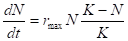 , which plots as a sigmoid curve. FTP, identify this model of
population growth which is based on the exponential model but incorporates the
effect of population density on r, allowing it to vary from rmax
under ideal conditions to zero as carrying capacity is reached.
, which plots as a sigmoid curve. FTP, identify this model of
population growth which is based on the exponential model but incorporates the
effect of population density on r, allowing it to vary from rmax
under ideal conditions to zero as carrying capacity is reached.
Answer: logistic population growth model
76) It occurs because the biomass at any given trophic level is produced from a much larger biomass ingested from the level below. In one example in Long Island Sound, three-millionths of a part per million of DDT in the water led to four-hundredths of a part per million in zooplankton, one-half of a part per million in small fish, two parts per million in large fish, and twenty-five parts per million in fish-eating birds. FTP, identify this phenomenon by which toxins become more concentrated with each link in the food chain.
Answer: biological magnification
77) A key strategy in restoration ecology, it takes advantage of the fact that some extremophilic bacteria and archaea, as well as some plants and fungi, thrive in environments similar to industrially polluted sites. Some, such as a uranium-dwelling species of lichen, can concentrate metals. The bacteria Pseudomonas is commonly used to clean up oil spills on beaches. FTP, identify this process in which living organisms are used to detoxify polluted ecosystems.
Answer: bioremediation
78) This man, nicknamed "the little botanist" as a child, received his medical degree at the University of Uppsala. He explored plant diversity in the Laplands, and in 1735 published Systema Naturae. FTP, identify this Swedish physician, the first person to create a uniform system for classifying and naming organisms.
Answer: Carolus Linnaeus
79) According to a report by the President's Council, it can be achieved by fostering stewardship, preserving opportunities for future generations, limiting population growth, improving education about environment and development, increasing community involvement, and devising new indicators to measure performance. According to William Clark in the 1998 Academic Decathlon Super Quiz book, the Brundtland report, Our Common Future, and Rio's Agenda 21 have helped to define and give impetus to this idea. FTP, identify this term for a pattern of human activity intended to improve the long-term prosperity of human societies and the ecosystems that support them.
Answer: sustainable development