Taiwan: Center-West (Changhua, Lukang, and Nantou County)
[June 2009 & 2010, November 2015 & 2016, March 2026]


[Source: https://en.wikipedia.org/wiki/Taiwan_Area
]
This page
presents photos I took during several trips to Changhua and Nantou Counties,
located to the south and southeast of Taichung City, respectively. The date of
each photo is indicated beneath it.
Changhua City (彰化市)
Changhua City
is the county seat of the namesake county. It is located just south of
Taichung.
Bagua Shan (八卦山):
This small
hill overlooking Changhua City was the site of the largest battle, fought on
August 27, 1895, between Japanese forces and the short-lived Republic of
Formosa, which lasted 151 days, from the formal cession of Taiwan by the Qing
dynasty to Japan on May 23, 1895, until the capture of Tainan, then the capital
of Taiwan, by the Japanese forces on October 21.
Giant Buddha
statue standing atop Bagua Shan. Completed in 1962, it measures 22m in height,
just a few meters less than the Maitreya Buddha statue at the Paouchen temple (寶覺禪寺) of
Taichung. It is an iconic landmark of Changhua.

[November 2016]
Changhua Yuanqing temple (彰化元清觀 (天公壇)):
Built in 1763, this temple is dedicated to the Jade Emperor (玉皇上帝). Destroyed by fire in 2006, it was rebuilt in December 2010.
Facade of the temple.

[March 2026]
Assembly of brick carvings located at
the base of the left wall in the entrance hall of the temple. Upon close
observation, one can distinguish two lions (one large and one small) playing
with a ball.

[March 2026]
Paintings of deified generals on doors of the temple. They are
believed to be guardians repelling evil spirits.
|
|
|
|


[March 2026]
Main courtyard.

[March 2026]
In the temple's main hall, which houses, at the rear, the altar
dedicated to the Jade Emperor (protected by a glass pane).

[March 2026]

[March 2026]
Decorated ceiling of the main hall.

[March 2026]
Changhua Confucius temple (彰化孔廟):
First built
in 1726, this Confucius temple is one of the oldest in Taiwan. It once served
as a major center for Confucian education in central Taiwan. It was partially
destroyed in the late 18th century, during the Lin Shuang-Wen Incident (林爽文事件), a major
revolt against Qing rule over the island. Its restoration, completed in 1830,
led to the temple that is roughly the one we can see today, despite subsequent
renovations.
First gate of
the temple, known as the Lingxing gate (欞星門).

[November 2016]
Second gate
of the temple, known as the Dacheng Gate (大成門), which
opens into the main courtyard of the temple. It is flanked by two moon gates
that also lead to the main courtyard.
|
|
|
|


[November 2016]
Main hall of
the temple, known as the Dacheng hall (大成殿, ″Hall
of Great Achievement″), which stands at the center of the main courtyard.


[November 2016]
Left: Close-up view of the entrance to
the Dacheng hall. Right: Altar located within the Dacheng hall. It houses the spirit tablet of Confucius,
which embodies his teachings.
|
|
|


[November 2016]
Changhua
City God Temple (彰邑城隍廟 仁愛侯):
A City God is a kind of divine magistrate who protects the city,
assists human officials to make decisions, records the merits and faults
of the city's inhabitants, and decides the kind of afterlife they
deserve. There are about 100 City God temples in Taiwan. The Changhua
City God temple was originally built in 1733, but the current temple is a
reconstruction dating from 1975.
Decorative replicas of traditional weapons standing on either side
of the temple entrance.

[March 2026]

[March 2026]
Main courtyard of the temple.

[March 2026]

[March 2026]
Altar dedicated to the City God, whose statue stands at the rear.
The other statues represent civil and military officials and judges, who serve
as his assistants. The two large statues on the left and right of the photo are
the Clerk and the Executioner of the Underworld, charged with recording the
merits and faults of the city's inhabitants and executing the verdicts of the
City God.

[March 2026]
Altar dedicated to Guanyin on the second floor of the temple.

[March 2026]
Changhua Ching'an temple (彰化慶安宮 保生大帝):
Built in 1817 by immigrants from what is today the Tong'an District of Xiamen City in Fujian Province, China,
this temple is primarily dedicated to Baosheng Dadi (保生大帝), also known as Dadaogong (大道公), a god of medicine and healing. It also enshrines Guanyin and
Wenchang Dijun as secondary deities. It was rebuilt in 1902, then damaged
during World War II, and again, by fire, in 1989. A restoration completed in
2002 returned the temple to its traditional style.
- Left: Facade of the temple.
- Right: Paper incinerator located next to the temple. Due to its
simple brick construction, its lack of ornamentation, and the absence of
filtration system, it is likely a ″jingziti″
(敬字亭,
″reverence-for-script pavilion″),
specifically used for the respectful incineration of paper bearing written
words, in order to honor those words, the culture they embody, and the scholars
who wrote them.
|
|
|


[March 2026]
Closeup of the central part of the roof ridge.

[March 2026]
- Center: Main hall of the temple, with
the altar dedicated to Baosheng Dadi at the back.
- Left and right: Two large, hollow effigies worn by individuals
during street parades and temple festivals to clear the path for the gods. They
are called Shen Jiang (神將), meaning ″Divine General″. During my visit, they were
located in the main hall, as shown in the photo in the center.
|
|
|
|


[March 2026]
Closeup of the altar dedicated to Baosheng
Dadi.

[March 2026]
Statues of three other divined generals, used during parades.

[March 2026]
Old-style Chinese lantern in the temple. It features polychrome
carved figures representing military characters.
|
|
|


[March 2026]
Changhua Guandi temple (彰邑關帝廟):
Originally built in 1735 inside the South Gate of Changhua by a
magistrate of Changhua County, this temple is dedicated to Guandi
(關帝), the God of War, the deified version of the general Guan Yu (關羽), who lived around 160-220. Moved to its current location in
1799, it later underwent several restorations, in 1829, during the Japanese
occupation, and after the retrocession of Taiwan. Its rear hall was damaged by
fire in 2017, but restored in 2018. Its main hall enshrines Guandi,
with his son Guan Ping (关平) and his faithful commander Zhou Cang (周倉) as secondary deities. The rear hall enshrines Wenchang Dijun (文昌帝君), the god of culture and literature.
Facade of the temple. Its unusual red color, which symbolizes
fortune, joy, prosperity, and vitality in Chinese tradition is intended to
honor Guan Yu's virtues of courage, loyalty, and righteousness,

[March 2026]
In the first courtyard of the temple, largely occupied by a tent
temporary erected for an upcoming celebration. Both sides of the tent display
images of Guandi.

[March 2026]
Altar dedicated to Guandi in the main
hall. Guandi stands at the center, flanked by his son
Guan Ping (關平) and his faithful commander General Zho Cang (周倉). (Unfortunatelythe statues are behind
a protective glass pane that reflects light.) The plaque at the top reads 威震海邦 (from right to left), which means ″ Striking Awe
Across the Seas″; it was offered by Hu Yingkui,
the magistrate of Changhua County, in 1798.

[March 2026]
- Left: Another statue of Guandi's son
Guan Ping.
- Center: Another statue of General Zho Cang.
- Right: Venerated replica of the ″Green Dragon Crescent
Blade″ (青龍偃月刀), the mythical polearm used by General Guan Yu.
|
|
|
|


[March 2026]
Altar dedicated to Wenchang Dijun (文昌帝君), the god of culture and literature, in the rear hall of the
temple. The statues of Wenchang Dijun, at the center, are flanked by his two
attendants, Tianlong (天聾, meaning ″Heaven-Deaf″) and Diya (地啞, meaning ″Earth-Mute″). The plaque above the altar is
inscribed with ″慧眾開靈″,
meaning ″Wisdom Enlightens the Spirit″.

[March 2026]
Altar dedicated to Zhao Gongming (趙公明), the chief martial god of wealth. He is the principal deity of Wu
Lu Caishen (五路財神, ″the Five-Way Gods of Wealth″), the collective name of
five deities who govern wealth from East, South, West, North, and Center. Zhao Gongming represents the Center and commands the other four
deities. Here, he is represented brandishing a cudgel, with a tiger under his
right foot. This representation symbolizes his ability to tame chaotic forces
and make them work for useful purposes. He is flanked by two attendants with
gold objects in their hands.

[March 2026]
Statue of Hu Ye (虎爺), the Tiger deity, placed beneath the altar of Zhao Gongming. Often identified as the deified tiger tamed by Zhao
Gongming, Hu Ye is regarded as a protective deity. Positioned under an altar as
is the case here, his statue designates him, more specifically, as a guardian
of the more important deity to whom the altar is dedicated.

[March 2026]
Lukang (鹿港)
Located on the west coast of Taiwan,
west of Changhua City, Lukang was a major port for
foreign trade under the Dutch and Qing periods. (The two characters that make
up its name, 港 and
鹿, mean ″port″ and ″deer″,
respectively.) It was once the second-largest city in Taiwan, after Tainan. Its
refusal to allow railroads to pass through its territory led to its decline,
but prevent the demolition of some of its historical buildings. It is home to a
well-preserved historical center, as well as to two important temples, one
Buddhist, the Lukang Longshan temple, and the other
Taoist, the Lukang Tianhou
temple.
Old Street (鹿港老街):
Lukang
Old Street (鹿港老街)
is a term that covers an entire historical neighborhood of Lukang.
Old merchant
houses and residences in the Old Street neighborhood. (The photo at the far
right in the second row of photos below shows the Banbian
well. This well was originally dug in such a way that half lies inside a
residence and the other half outside, in order to make its water accessible to
passersby. It is no longer in use.)
|
|
|
|


|
|
|


|
|
|


[November 2016]
Ding Family house (鹿港丁家古厝):
Located about
500m south of the Old Street neighborhood, this house was originally built in
the mid-19th century by the Wang family. Ding Xieyuan
purchased it in 1893 from its original owners. It was restored in 2005.
Entrance of
first hall.

[November 2016]
Close-ups of
the decorative panels adorning the entrance to the first hall.
|
|
|
|
|


[November 2016]
Second hall.

[November 2016]
Inner
courtyards.
|
|
|
|


[November 2016]
Old photos of
family members suspended on the walls.

[November 2016]

[November 2016]
Lukang Longshan temple (鹿港龍山寺):
Founded
around 1647, this temple is the earliest of the five remaining Longshan temples
in Taiwan dating back to the Qing dynasty; it is also the largest and the best
preserved. All these five temples were founded by early Hokkien immigrants from the Quanzhou region in the
Fujian province and named after their ancestral temple on the Dragon Mountain (龍山). They are
Buddhist temples primarily dedicated to Guanyin (觀音菩薩), the highly
popular bodhisattva of infinite compassion in Chinese Buddhism. But, over time,
the worship of other Buddhist and Taoist deities was added to these temples.
First
entrance gate to the temple.

[November 2016]
Magnificent
second gate, which features numerous wood and stone carvings.

[November 2016]
Middle
section of the second gate.

[November 2016]
One of the intricately carved windows of
the second gate.

[November 2016]
Central ceiling in the hall behind the
second gate.

[November 2016]
Temple guardians painted on the doors of
the second gate.
|
|
|
|


[November 2016]
Local
musicians playing in the hall behind the second gate, in front of the main
hall.


[November 2016]
Left: Roof of the main hall. Right: View
through an octagonal bagua gate on the side of the main hall (toward the second
gate).
|
|
|


[November 2016]
Wood carvings in the entrance of the
main hall.

[November 2016]
Ceiling of the main hall.

[November 2016]
Altar dedicated to Guanyin in the main
hall.

[November 2016]
Lukang Tianhou (Mazu) temple
(鹿港天后宮):
This Mazu temple
was built in 1643 at another location, then moved to its current site in 1725.
During its history it was rebuilt and renovated several times. It is known as
both the Mazu and Tianhou temple of Lukang. These two names designate the same Taoist goddess of the sea:
Mazu (妈祖) is an
affectionate name meaning ″Maternal Ancestor″, while Tianhou (天后) is a formal
honorary title meaning ″Heavenly Empress″.
Zhongshan Road leading to the Lukang Mazu temple, on a sunny Sunday afternoon.

[November 2016]
Exterior view of the temple.

[November 2016]
It was a day
of celebration in the temple. The first courtyard was crowded with visitors and
worshippers,

[November 2016]

[November 2016]

[November 2016]
Large effigies called Shen Jiang (神將, ″Divine General″) [See Changhua Ching'an temple (above)].
|
|
|


[November 2016]
Roofs of the
temple.

[November 2016]

[November 2016]
|
|
|


[November 2016]
Main altar dedicated to Mazu. The air
there was heavy with the smoke of incense.

[November 2016]
Altar dedicated to Yue Lao (月下老人, ″The Old Man Under the Moon″),
the god of love and matchmaking.

[November 2016]
- Left: Large pillars adorned with
hundreds of small lights known as Guang Ming Deng (光明燈).
- Right: Delicately carved incense
burner.
|
|
|


[November 2016]
Nantou County (南投縣)
Located in central Taiwan, east of
Changhua County, Nantou County is Taiwan's second-largest county and the only
one with no sea coast. Primarily rural and mountainous, it is home to a
relatively large number of indigenous communities. Sun Moon Lake, Taiwan's
largest lake, is undoubtedly its most famous site.
Ming Huan, a member of the Bunun aboriginal groups,
one the three mountain aboriginal groups in Taiwan. He lives near Dongpu, in Nantou County. He was my guide during a one-week
trek in Yushan National Park in November 2015.

[November 2015]
Puli Hengji temple (埔里恒吉宮):
Located in the town of Puli, this Mazu
temple was founded in 1887 by a merchant originally from Xiamen, in China.
Rebuilt in 1924, during the Japanese colonial era, it became a prominent local
temple. It was reconstructed again between 1987 and 1994. During the earthquake
of September 21, 1999, the roof of the rear hall, weighing approximately 400
tons, collapsed onto the third floor. The temple was restored in 2004 by
jacking up the roof and repositioning it on the temple.
Large joss paper burner (left photo) and
facade (right photo) of the temple.
|
|
|


[November 2015]
Main hall housing the altar dedicated to
Mazu.

[November 2015]
Puli Wine Exhibition Center (臺灣菸酒股份有限公司 埔里酒廠 展售中心):
The center, also located in Puli, is famous for its Shaoxing wine, a rice
wine used in cooking.
Lines of wine jars exposed in the center.

[November 2015]
Chung Tai Chan Monastery (中台禪寺):
Located 5km
north of Puli's center, this Buddhist monastery is the largest in Taiwan. Its
construction was completed in 2001. It has been the subject of several disputes
in Taiwan, notably due the ordination of college students as nuns without their
families' knowledge and the illegal
construction of buildings on protected lands. During my visit in June 2009, the
presence of a nun-guide was mandatory to tour the temple, and photography was
prohibited almost everywhere.
Statues in
the entrance of the monastery:
- Left:
Maitreya Buddha, depicted as a happy, prosperous monk.
- Right:
Bodhidharma, the first patriarch of Chinese Zen Buddhism, represented in
meditative posture. The statue is carved from Indian red granite.
|
|
|


[June 2009]
Sun Moon
lake (日月潭):
Located about
10km southwest of Puli, this lake is not only the largest in Taiwan, it is also
one of its most popular tourist destinations. Unfortunately, it is
over-developed.

[November 2016]
Floating
islands of aquatic plants planted on soil-covered bamboo rafts. They clean
water and protect the shores against erosion.

[November 2016]
Wenwu temple (日月潭 文武廟):
This temple
was originally built in 1938 to replace smaller temples threatened by rising
waters due to the construction of a hydroelectric dam. It was rebuilt on the
northern hillside of Sun Moon Lake between 1969 and 1975 as an opulent temple
in the grand Northern Chinese palace architectural style, and subsequently
restored after the 1999 earthquake. It consists of three main halls. The first
two are dedicated primarily to both Guandi (關帝), the god of
war, and Wenchang Dijun (文昌帝君), the god of
culture and literature. However, they also enshrine many other deities,
including Buddhist ones, as secondary deities. The third hall is dedicated to
Confucius and his companions, the Four Sages (四配).
View of the
temple overlooking the lake.

[November 2016]
Large
sculpture of a guardian lion at foot of the temple.

[November 2016]
First Hall.

[November 2016]
Second hall.

[November 2016]
Ceiling
decorations in the temple

[November 2016]
Statue of Guandi (center), flanked by two
attendants holding yuanbao (元寶), boat-shaped gold ingots used as
currency in Imperial China. The statue situated furthest to the left, holding a
polearm, is Guandi's commander,
General Zho Cang (周倉). The one standing furthest to the right represents his son, Guan
Ping (关平).

[November 2016]
Altar dedicated to Guandi (statue on the right with a red face) and King Yue Wumu (岳武穆王).
Yue Wumu is the deified version of Yue Fei (岳飞), a
12th-century general during the Southern Song dynasty famous for his loyalty, military skills, and
ultimate wrongful execution.

[November 2016]
Altar
dedicated to Tudigong (土地公), also known as Fude Zhengshen (福德正神), the God of Earth and Merit.
[November 2016]
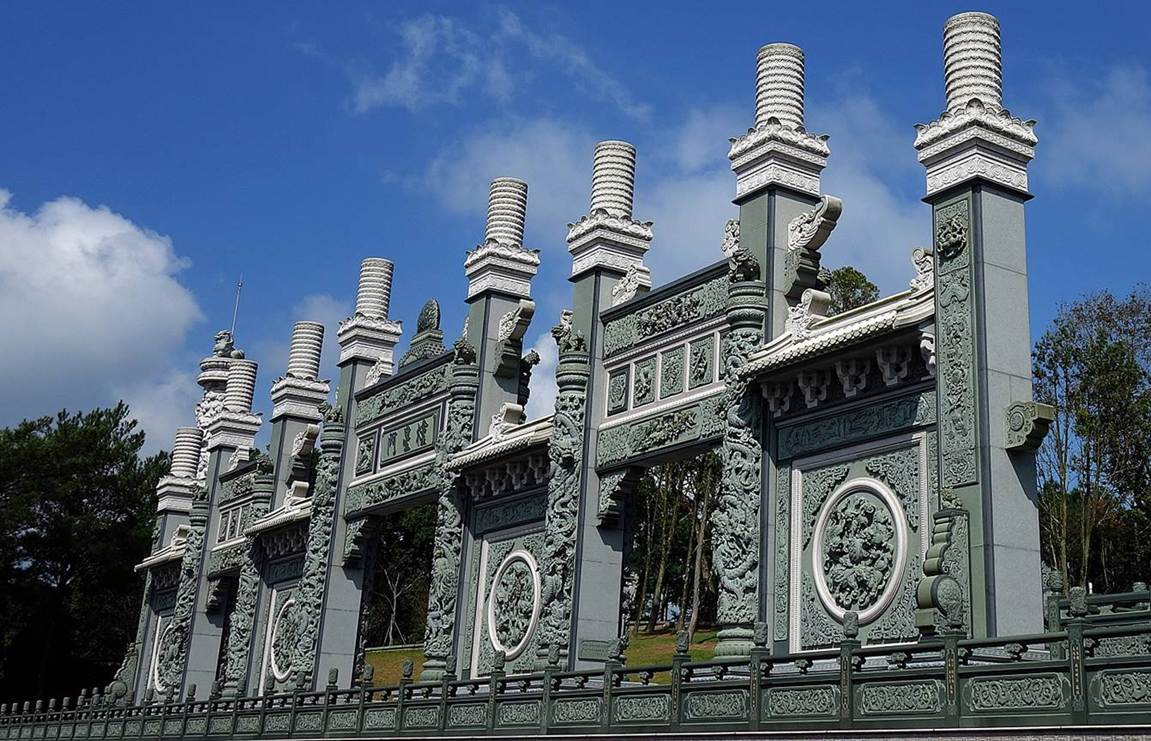
Lingxing gate (欞星門), located at
the top of the temple beyond the Confucius temple.
[November 2016]
Stone relief carvings on the wall below
the Lingxing gate.


[November 2016]
Roofs of the Wenwu temple seen from the
upper levels.

|
|
|


[November 2016]
Xitou Forest (溪頭自然教育園區):
Xitou Forest is a protected nature area
offering a variety of beautiful short hikes. It is located about 20km southwest
of Sun-Moon Lake.
Arriving at Xitou
Forest in a nicely decorated taxi.

[June 2009]
View along hikes in
the forest preserve.
|
|
|


[June 2009]
Tea
plantation next to Xitou Forest.

[June 2010]