Taiwan: Penghu Islands (2015)

The little known (outside Taiwan) Penghu Islands are located in the
strait between Taiwan and China. They form an archipelago of 64 islands. The
main island is Magong (meaning: ″Matsu Palace″), which is connected
through bridges to 3 other islands. These 4 islands form 3 townships: Magong,
Huxi (also located on Magong Island), Baisha, and Xiyu.
Despite their small size, but because of
their strategic location, the Penghu Islands are rich in history. A little
known fact in both Penghu and French history is the following: in March 1885
during the short Sino-French War, French Admiral Anatole-Amedee-Prosper Courbet
captured the Penghu Islands, then known to him as the Pescadores Islands. But
he died in June of the same year aboard his flagship Bayard in Magong harbor.
|
|
|


Fishing is a major component of Penghu‛s
economic activity. Penghu fishing boats are characterized by their spiky bows.

|
|
|


Statue of the Fisherman at the eastern
tip of Xiyu Island, near the Great Bridge connecting the Baisha and Xiyu
islands.
|
|
|


Women repairing fishing nets.


Cleaning oysters and afternoon auction sale
of a fish catch in Magong harbor.

|
|
|


Penghu Islands are not short on temples.
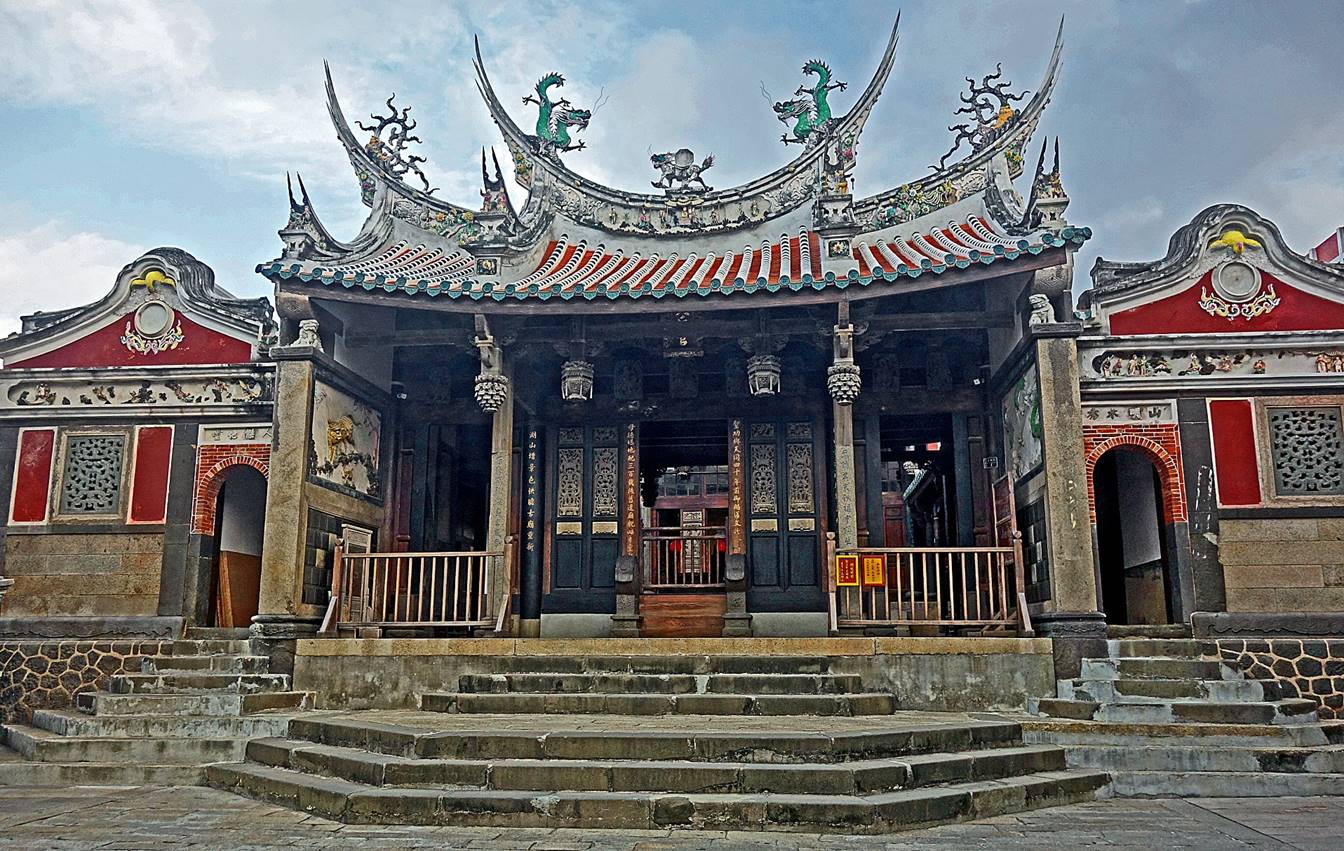
In Magong City, the beautiful Penghu Tianhou temple (澎湖天后宮) is the oldest temple dedicated to
Mazu, the Taoist goddess of the sea, in all Taiwan. Its origin dates back to
the late 16th century. But it was reconstructed and renovated several times
during its history. The latest major renovation was performed in 2011-2014.
[Note: Mazu and Tianhou are two names designating the same Taoist goddess of
the sea: Mazu (妈祖) is an
affectionate name meaning ″Maternal Ancestor″, while Tianhou (天后) is a formal honorary title meaning ″Heavenly
Empress″.]
- Main entrance gate.
- Two of the wood carvings below the
ceiling of the entrance gate. (Several such carvings are barely visible in the
above photo.)

- Inner courtyard.


- Left: Incense burner in the main
entrance gate. Right: Altar in the main hall of the temple.
|
|
|


Extravagant roof of the Penghu Ziwei
temple (澎湖紫微宮) on Magong Island. This seven-story temple
was constructed between 2000 and 2006. The tall statue erected on the roof
represents Emperor Ziwei (紫微大帝), the Great Emperor of
the North Star, the principal deity enshrined in the temple. He is prayed to
for the bestowal of good fortune, divine protection, and cosmic harmony.

Left: A typical soulless modern
Taiwanese hotel in Magong city. Right: A 10m-high circular ″shita″
in the southern part of Magong township.
[A ″shita″ is a religiously significant
stone tower believed to protect villagers and fishermen against strong winds.
It is similar in purpose to the Wind Lion God statues on Great Kinmen island
(see here).]
|
|
|


Walking on water
in Kuibishan (north-east of Magong Island). When tide level is receding a
narrow footpath slowly appears between Magong Island and tiny Chi islet.
|
|
|


Sacred large
banyan tree in the village of Tongliang (western tip of Baisha Island) in front
of the Baoan Temple (通梁保安宮):
- It has
nearly 100 aerial roots that have been gathered to form an array of columns.
Covering an area of 660 square meters, it is said to provide the largest shade
in Penghu.


- Left: all
the aerial roots derive from this less-than-impressive initial trunk, revered
as a deity by the people of Penghu. Right: nicely decorated ghost money burner
under the banyan tree next to the temple.
[Ghost money, also called fake money, joss paper...,
usually consists of printed paper. Its burning is widespread in Taiwan to honor
ancestors and venerate deities. In addition to temples, many houses have their
own small money burners. Estimates
of the amount of ghost money paper burned each year range from 90,000 to
220,000 tons. It is a major cause of air pollution in urban areas,
especially during the Ghost Festival. Some people now try to replace this
tradition with cleaner on-line virtual money burning!]
|
|
|


Inside the Baoan
Temple. The temple is over 100 years old.


|
|
|
|
|


Xiaomenyu, at the northern tip of Xiyu Island:
- The basaltic Whale Cave.

- The north coast at sunset.

Old traditional houses constructed in classic Fujian style in Erkan
village (central Xiyu Island).


|
|
|


Daguoye columnar basalt cliff (central Xiyu Island).


Xiyu Western
Fort, initially built in 1681 to defend Penghu against attacks by Qing Dynasty
admiral Shi Lang, renovated in 1717 and extended in 1883. It is located on the
southern coast of Xihu Island.


Yuweng Tao
Lighthouse built in 1875 to replace a previous lighthouse built in 1778, which
was the first known lighthouse in Taiwan history. It is located at the
southwestern tip of Xihu Island.
|
|
|

