Welcome to the blog. I finally decided to kick off this blog to share my thoughts on my recent research and readings.
I hope to update this blog regularly, but I have no idea when I will write the next post.
Disclaimer: I came up with this rhyming metaphor and ChatGPT helped me turn it into a real blog post.
Hubble and Bubble
The Hubble Space Telescope (HST), named after the astronomer Edwin Hubble, is one of the humanity's most remarkable instruments. It is a telescope orbiting above the earth's atmosphere, capturing deep-field images that stretch billions of years into the past since its launch in 1990. It embodies patience, rigor, and the ambition to truly understand the universe. One of the most iconic images captured by Hubble might be The Pillars of Creation.
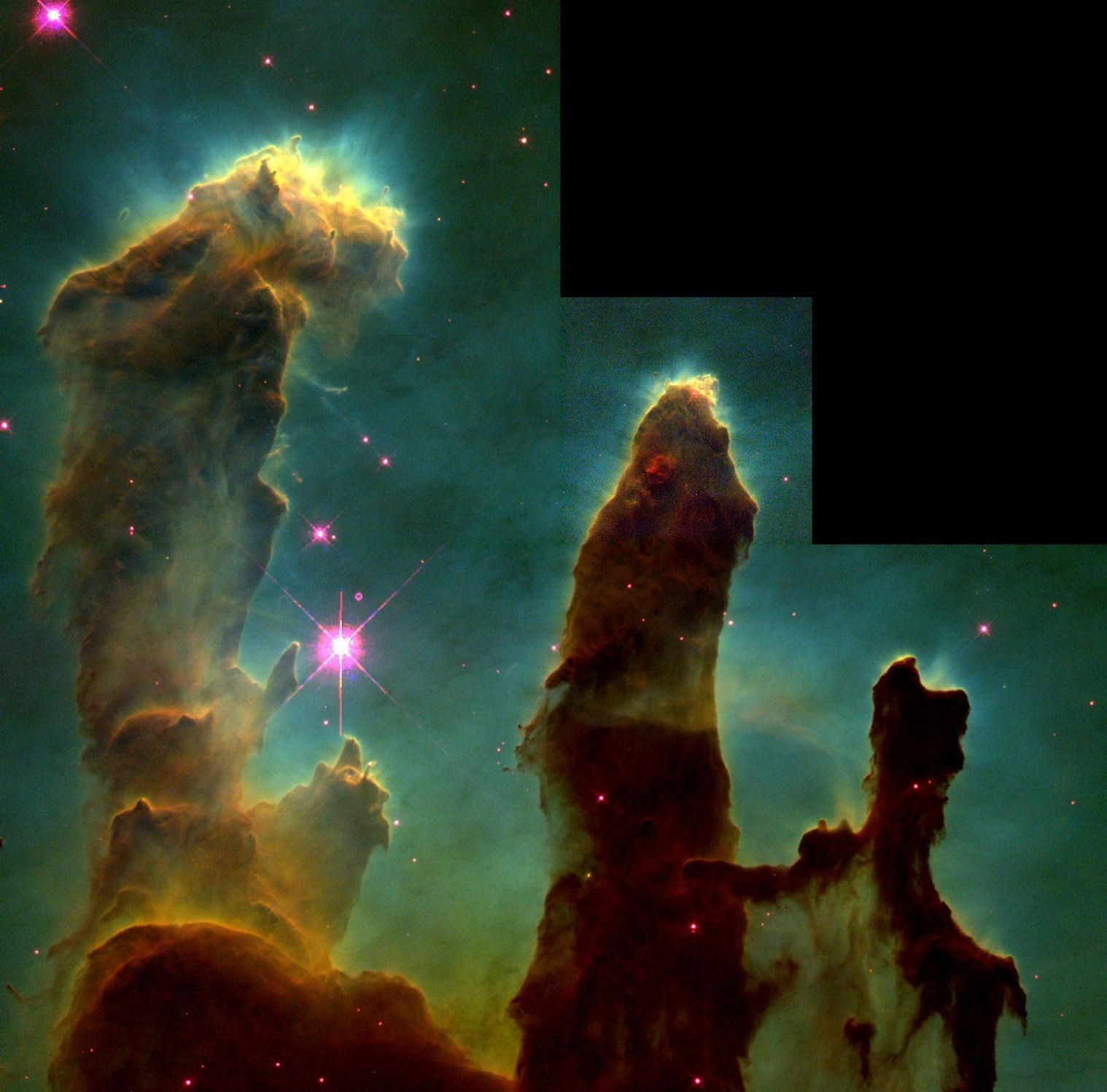
The Pillars of Creation by NASA via this link.
The late 1990s and early 2000s, in contrast, gave us the dot-com bubble: a frenzy of speculation, paper valuations, and companies built on buzzwords rather than fundamentals. The bubble burst, leaving behind a trail of bankrupt startups and cautionary tales about hype exceeding reality.Signal and Noise
Today's Internet supercharges bubble-making. Echo chambers amplify noise, hype cycles accelerate, and fragile trends blow up and vanish in weeks. For every meaningful breakthrough, there are thousands of distractions masquerading as insight. Hubble represents the opposite impulse: instruments, ideas, and practices that help us see farther and think deeper. Scientific research is, at its core, a search for signal—what is real, true, and enduring beneath all the noise.
Resilience and Fragility
A bubble pops at the slightest pressure. It thrives on speculation and collapses when reality intrudes. Hubble, by contrast, has operated for 35 years and continues to deliver discoveries. Its longevity reflects what good research aspires to: resilience, relevance, and the ability to stand the test of time. Great science doesn't wilt when poked—it strengthens.
Hardness and Softness
The Hubble was incredibly hard to build. It required decades of engineering, billions of dollars, and coordination across agencies and disciplines. And even then—its mirror was flawedLink. at launch. It took a repair mission in orbit to fix a fundamental mistake. Science works the same way. It is hard. It is expensive. It is full of errors that must be identified, corrected, and refuted. But once those corrections are made, the resulting knowledge can transform how we understand everything. Progress depends not on avoiding error, but on embracing refutability.
What It Takes to Make a Hubble
Building a Hubble—literal or metaphorical—requires more than inspiration. It demands science, technology, systems engineering, and long-horizon thinking. It is about aligning vision with discipline and shaping tools that amplify understanding rather than hype. If we want a future shaped by clarity rather than bubbles, we need to invest in Hubble-like efforts: deep science, robust engineering, and ideas designed to last.